

Head of a Priest of Serapis (Unfinished)
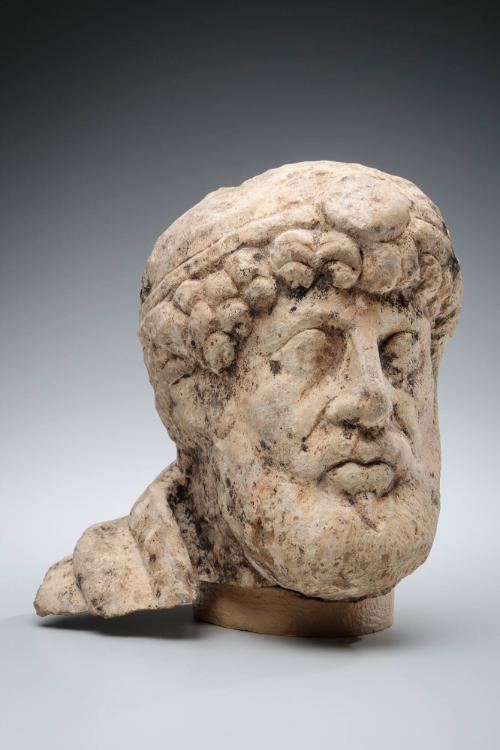

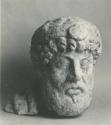
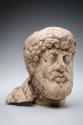
Head of a Priest of Serapis (Unfinished)
Place of OriginEgypt, found at Sakkara
Date150-200 CE
DimensionsH: 10 1/2 in. (26.7 cm)
MediumMarble. Isotopic and petrographic studies (R.H. Tykot, 2007–2008) identified the marble as originating from Aphrodisias or, less likely, the Paros Lychnites quarry. This confirms that the stone was an imported luxury material not native to Egypt.
ClassificationSculpture
Credit LineGift of Edward Drummond Libbey
Object number
1925.153
Not on View
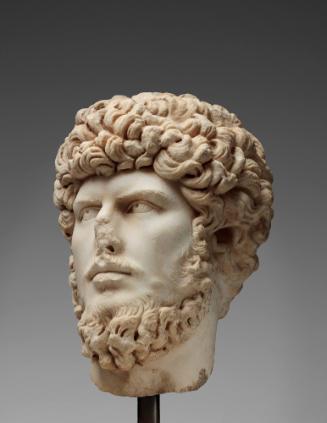
DescriptionFragmentary marble head of a bearded man, carved in the round from fine-grained Greek marble and broken at the neck. The hair and beard are only roughly blocked out, with chisel marks visible and no final surface polish, indicating an unfinished state. The man wears a low diadem across the forehead with an oval recess for an inlay—likely a seven-pointed star associated with the god Serapis. Traces of a himation draped over the left shoulder show that the head belonged to a life-sized statue or bust. Areas of red pigment survive in the eyes, nostrils, and mouth, suggesting partial application of paint before the carving was completed.
Label TextThis fragmentary marble head portrays a bearded man wearing a narrow diadem, once fitted with an oval setting for a seven-pointed star—the emblem of the god Serapis. The diadem resembles those worn by priests of the imperial cult in Asia Minor, suggesting a position of religious authority. Faint remains of a Greek-style himation over the left shoulder indicate that the head belonged to a life-sized statue.
The sculpture remains only partially worked: the beard and hair are roughly blocked out and the surface lacks final polish. Yet traces of red pigment survive around the eyes, nose, and mouth—evidence that the figure was at least partly painted. The facial proportions and heavy-lidded eyes recall portraits of Hadrian, though the incompleteness prevents a secure identification.
The piece relates closely to other portraits of Serapis devotees: a family relief in Cairo (Egyptian Museum C.G. 27568), a limestone head from Tebtynis (J.E. 65424 A), a marble head in Berlin (Antikensammlung Sk 1810), and the Getty Villa Portrait Bust of a Man, Perhaps a Priest of Serapis (71.AA.453). Carved from imported marble, probably from Aphrodisias or Paros, the head exemplifies the cosmopolitan artistry of Roman Egypt.
Published ReferencesUnpublished.Exhibition HistoryDayton (OH) Art Institute, The Roman World: Religious and Everday Life, 2007-2008 (no catalogue or checklist).Toledo Museum of Art, The Mummies: From Egypt to Toledo, February 3- May 6, 2018.
Comparative ReferencesCf. Kiss, Zsolt, Études sur le portrait impérial romain en Égypte, Warsaw, PWN – Éditions scientifiques de Pologne, 1984.Cf. Grimm, Günter, Kunst der Ptolemäer- und Römerzeit im Ägyptischen Museum Kairo, Mainz, Philipp von Zabern, 1975.
Cf. Graindor, Paul, Bustes et statues-portraits d’Égypte romaine, Cairo, Grenier & Barbey, 1937.
See also Walker, Susan and Morris Biebrier, Ancient Faces: Mummy Portraits from Roman Egypt, The British Museum, London, 2008, cat. no. 21 (exhibition catalogue; refer to the painted portrait of a priest of Serapis).

Late 2nd or 1st century BCE
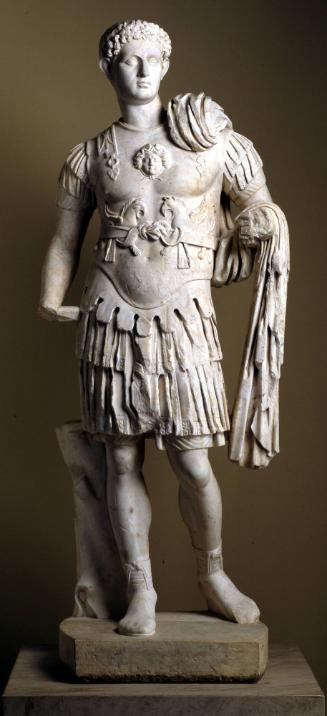
Hadrianic (about 130 CE)
161-169 CE

Early Cycladic I, about 3000-2800 BCE

about 90 CE
2nd century CE

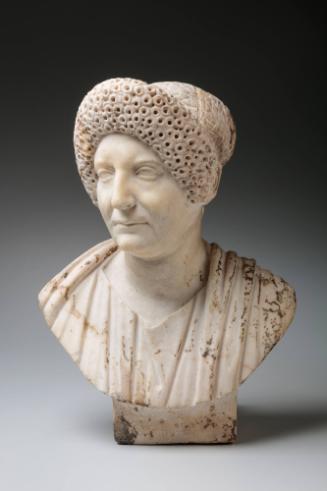
c. 90 CE

280-290 CE (with 15th century recarving)

after 87-89 CE

Membership
Become a TMA member today
Support TMA
Help support the TMA mission