

Box Mirror with Relief Head and Crouching Aphrodite
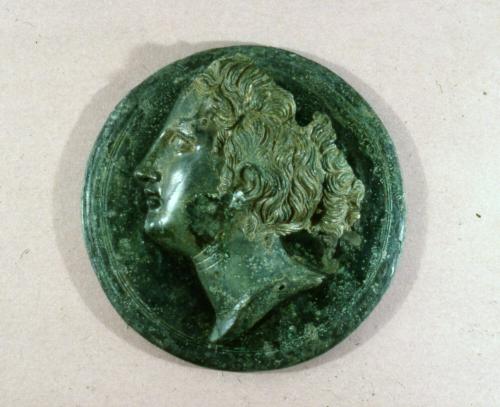

Box Mirror with Relief Head and Crouching Aphrodite
Place of OriginSouth Italy, possibly Apulia
Dateabout 320 BCE
Dimensionsmirror disc: 5 7/16 × 5 1/2 × 5 1/2 × 3/8 in. (13.8 × 14 × 14 × 1 cm)
cover: 5 3/8 × 5 × 5 1/4 × 1 3/8 in. (13.7 × 12.7 × 13.3 × 3.5 cm)
cover: 5 3/8 × 5 × 5 1/4 × 1 3/8 in. (13.7 × 12.7 × 13.3 × 3.5 cm)
MediumBronze with solid tin plating.
ClassificationMetalwork
Credit LinePurchased with funds from the Libbey Endowment, Gift of Edward Drummond Libbey
Object number
1966.111A-B
On View
Toledo Museum of Art (2445 Monroe Street), Gallery, 02, Classic
DescriptionA circular bronze box mirror consisting of a reflecting disc and a hinged cover (hinge mechanism now missing). The obverse of the cover features a high-relief repoussé bust of a woman in profile facing left; she features wavy hair swept back from the face, a fleshy neck with "Venus rings," and wears a disc earring. A small perforation exists at the base of the neck. The interior of the cover displays an engraved scene against a tinned, silvery background; the scene depicts a nude female figure (Aphrodite) crouching in profile to the left, wearing a bracelet and a band across her chest, situated in a rocky grotto or cave indicated by schematic lines; to her right is a basin. The reverse of the mirror disc is decorated with a series of turned concentric circles. The interior surfaces show remnants of tin plating intended to imitate silver.
Label TextResembling a modern compact, this hinged mirror was designed to protect the polished bronze reflecting surface inside. The cover is embellished with a high-relief profile of a woman—likely Aphrodite, the goddess of love—created using the repoussé technique, where the metal is hammered from the reverse side.
Opening the case reveals a private, intricate engraving on the underside of the lid: Aphrodite crouching for her bath in a secluded grotto. Technical analysis reveals that the interior was originally plated with tin to simulate the appearance of shimmering silver, adding to the object's luxury. While originally thought to be from Athens, recent research suggests this mirror was crafted in the Greek colony of Taras (modern Taranto) in Southern Italy.
Published ReferencesToledo Museum of Art, "Treasures for Toledo," Toledo Museum of Art Museum News, new series, vol. 12, no. 4, Winter 1969, repr.Cooney, John D., "Deluxe toilet objects," Bulletin of the Cleveland Museum of Art, vol. 60, no. 7, Sept. 1973, pp. 219-221, repr. fig. 8, 9, p. 221.
Schwarzmaier, Agnes, Griechische Klappspiegel: Untersuchungen Zu Typologie Und Stil," Mitteilungen des Deutschen Archaologischen Instituts Athenische Abteilung, Beiheft, 1997, pp. 15, 46, 47, 132, 135, 136, 156, 191, 195, 212, 279, 300, 331, Taf. 64.1 and 82.2.
Gazda, Elaine K. (ed.), The Villa of the Mysteries in Pompeii: Ancient Ritual, Modern Muse, Ann Arbor, Kelsey Museum of Archaeology, 2000, pp. 153–154, no. 3, repr.
Exhibition HistoryAnn Arbor, Kelsey Museum of Archaeology and The University of Michigan Museum of Art, The Villa of the Mysteries in Pompeii: ancient ritual, modern muse, 2000.Comparative ReferencesSee also Richter, G.M.A., A Handbook of Greek Art, London, 1960, pp. 208, 209, figs. 313, 314.cf. Zücher, Wolfgang, Griechische Klappspiegel, Berlin, Walter de Gruyter & Co., 1932.
cf. Rolley, C., Monumenta Graeca et Romana, vol. 5, Greek Minor Arts, fasc. 1, The Bronzes, Leiden, 1967, no. 171, fig. 171.


2nd century BCE
250-150 BCE

about 300 BCE
about 15-30 CE

1st millennium BCE

Membership
Become a TMA member today
Support TMA
Help support the TMA mission