

Hookah Base
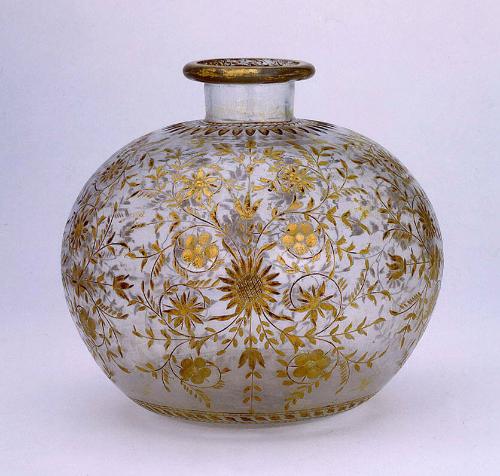

Hookah Base
Place of OriginIndia
DateMughal period, second half of the 18th century
DimensionsH: 6 1/4 in. (16 cm); Max Diam: 6 3/8 in. (16.2 cm)
MediumPale yellowish glass; free-blown, tooled on the pontil, wheel-cut and gilded.
ClassificationGlass
Credit LinePurchased with funds from the Libbey Endowment, Gift of Edward Drummond Libbey
Object number
2005.47
Not on View
DescriptionHookah base of globular form with a constricted neck and thick, flaring rim. The wall is decorated overall with a wheel-engraved and gilded pattern of floral arabesques and birds. A double pontil mark is located under the center of the base.
Published ReferencesCarboni, Stefano and David Whitehouse, Glass of the Sultans, New York, 2001.
Page, Jutta-Annette, The Art of Glass: Toledo Museum of Art, Toledo, Ohio, Toledo Museum of Art, 2006, p. 71-72, repr. (col.) fig. 27C, p. 73.
Desjardins, Tara, Mughal Glass: A History of Glassmaking in India Lustre Press, Roli Books, 2025, p. 240 repr. (col.).
Comparative ReferencesSee also Stefano Carboni, Glass from Islamic Lands, 2001, pp. 380 and 382, cat. no. 104b.
Mughal period, late 18th century
about 1350-1360
Late 13th century

Probably 1920s

about 1720-1725


12th century
4th-5th century CE (?)

Membership
Become a TMA member today
Support TMA
Help support the TMA mission