

Rhyton in the Shape of a Boar's Head


Rhyton in the Shape of a Boar's Head
Artistattributed to
Painter of Louvre MNB 1148
(Greek, active 350-330 BCE)
Place of OriginItaly, Apulia, attributed to Tarentum
Date340-330 BCE
Dimensions5 3/4 × 8 1/4 × 4 3/8 (14.6 × 21 × 11.1 cm)
Rim Diam: 4 3/8 in. (11.1 cm)
Rim Diam: 4 3/8 in. (11.1 cm)
MediumMolded and wheel-thrown earthenware with slip decoration
ClassificationCeramics
Credit LinePurchased with funds from the Libbey Endowment, Gift of Edward Drummond Libbey and the Latin Students of Donnell Jr. High School
Object number
1988.39
On View
Toledo Museum of Art (2445 Monroe Street), Gallery, 02, Classic
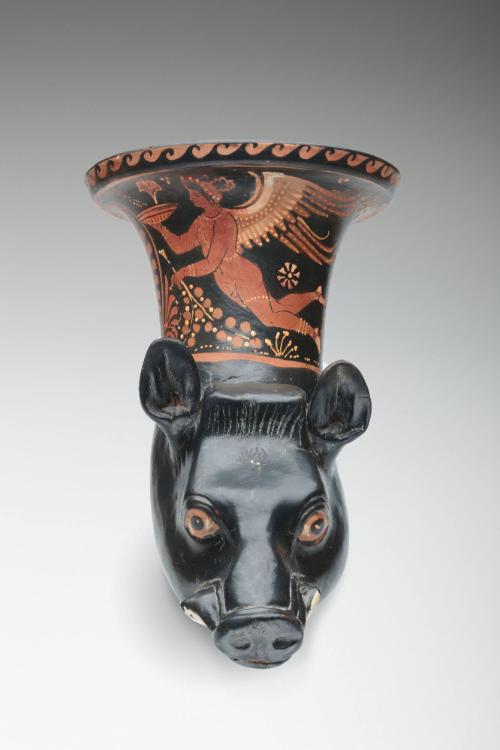
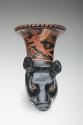
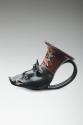
DescriptionA ceramic vessel constructed in two sections: a lower mold-made protome shaped as a boar's head and an upper wheel-thrown neck with a flaring rim. A single handle connects the back of the rim to the base of the head. The surface is covered primarily in black slip. The neck features a red-figure panel depicting a winged figure. The boar's head details—including tusks, teeth, whiskers, and eyes—are embellished with added white slip and reserved clay. The interior of the ears and eyes are reserved.
Label TextThis drinking cup, or rhyton, combines the ferocity of the wild with the elegance of the afterlife. The lower section is molded in the form of a charging boar, rendered with fiercely realistic tusks, whiskers, and dripping saliva—details emphasized with white clay slip. Above, the neck depicts the winged god Eros, a symbol of the blessed afterlife often found on South Italian funerary pottery. Unlike Athenian rhyta used at drinking parties, this vessel from Tarentum (modern Taranto) was likely made exclusively as a tomb offering.Published ReferencesRoth, Evan, "Ancient Greek vases: The Toledo Museum of Art," Museum News [AAM], vol. 69, no. 1, Jan./Feb. 1990, p. 39, repr. (col.).
Trendall, A.D. and Alexander Cambitoglou, Second Supplement to the Red-Figured Vases of Apulia, London, 1991, pl. 1, p. 181.
Comparative ReferencesSee also Hoffmann, Herbert, Tarentine Rhyta, Mainz, 1966, pp. 52-58, especially nos. 303-304, pls. XXXIV, 1, 2.
750-650 BCE

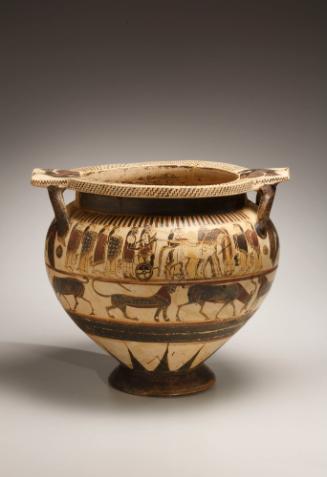
Unidentified, Gorgoneion Group
about 560 BCE



Workshop of the potter Nikosthenes
about 520 BCE


1850-1865

Membership
Become a TMA member today
Support TMA
Help support the TMA mission