

Bottle with Facet-Cut Decoration
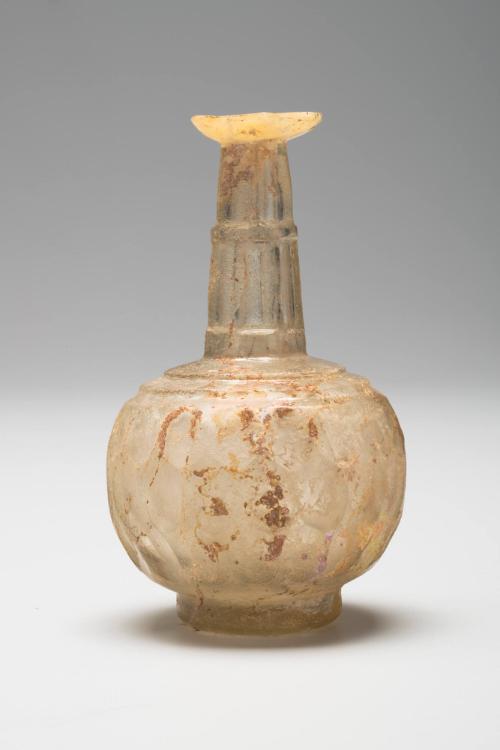

Bottle with Facet-Cut Decoration
Place of OriginLikely Iran
Date7th-8th century
DimensionsH: 6 1/8 in. (15.3 cm); Rim Diam: 1 3/4 in. (4.4 cm); Body Diam: 3 5/8 in. (9.2 cm)
MediumBlown glass, with wheel-cut decoration
ClassificationGlass
Credit LineGift of Edward Drummond Libbey
Object number
1923.2134
Not on View
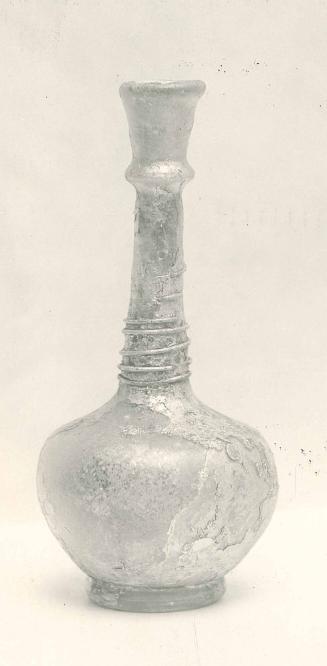
DescriptionThe bottle is made of colorless glass. It has a flared, six-sided rim above a neck that widens as it descends toward the shoulder. The neck is cut in two tiers of rectangular facets, which are separated by a raised ridge. A second ridge marks the juncture of the neck and shoulder. The shoulder is cut into three tiers, while the main body is decorated with circular facets. The vessel is supported by a circular base.
Label TextSasanian glass (224–651 CE) continued earlier Parthian traditions but reached new levels of refinement. Craftsmen favored free-blown forms, often with applied trails, indents, or cut facets that played with light on transparent walls. Bowls, bottles, and beakers were produced in clear or softly tinted glass, sometimes imitating precious rock crystal. After the fall of the Sasanian Empire, glassmaking in Islamic lands inherited these techniques. Early Islamic artisans adapted Sasanian forms while introducing new decorative approaches such as lustre painting and elaborate mold-blowing. Thus, post-Sasanian glass carried forward both the aesthetic and technical legacy of late antique Iran.Exhibition HistoryDenver, CO, Denver Museum of Nature and Science, Traveling the Silk Road: Ancient Pathways to the Modern World, 2014-2015.
about 375-550
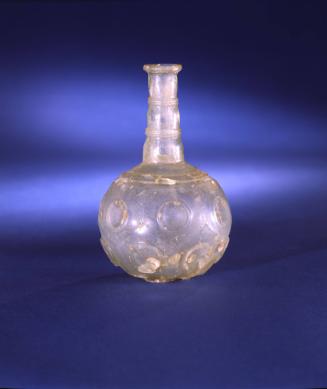
7th-8th century
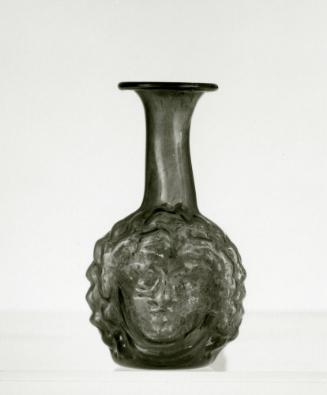

Second half of the 1st century CE
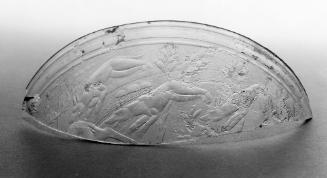
3rd-4th century CE

5th- early 7th century CE

9th-10th century
about 12th century
1st century BCE - 4th century CE

Membership
Become a TMA member today
Support TMA
Help support the TMA mission