

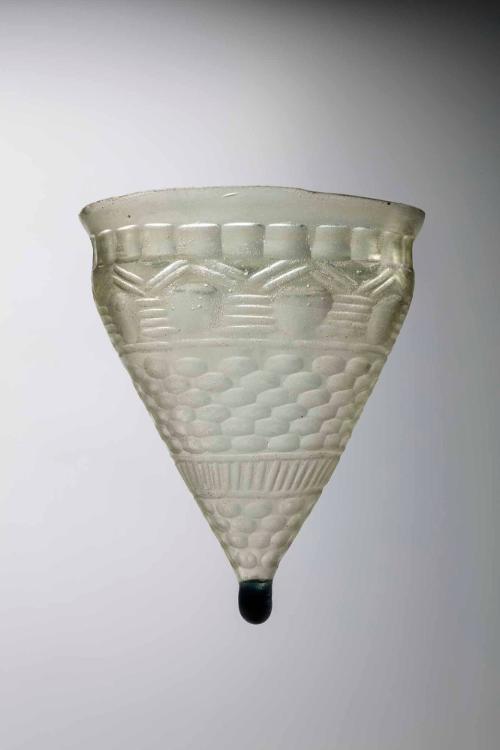
Hanging Lamp with Facet-Cut Arcade Pattern


Hanging Lamp with Facet-Cut Arcade Pattern
Place of OriginProbably Iran, Southern Caucasus or Mesopotamia
Dateabout 375-550
Dimensions5 1/16 × 4 1/4 in. (12.9 × 10.8 cm)
Mediumglass
ClassificationGlass
Credit LinePurchased with funds from the Libbey Endowment, Gift of Edward Drummond Libbey
Object number
1981.96
Not on View
DescriptionA conical glass vessel with a slightly flared, unworked rim and a pointed base terminated by an applied drop of dark cobalt blue glass. The body is blown from colorless glass with a natural greenish tint. The exterior surface is extensively wheel-cut in a complex architectural design, removing much of the original surface. The decoration is organized in horizontal registers: a band of square facets below the rim; a main frieze of arcade arches supported by piers, created with narrow wheel cuts; oval facets; and a lower band of vertical cuts. The distinct inward turn of the profile just below the lip creates a slight shoulder.
Label TextThis elegant glass vessel was made between the 4th and 6th centuries CE during the rule of the Sasanian Empire, which once stretched across modern-day Iran and parts of the Middle East. Shaped in a conical form and made from clear glass with a slight greenish hue, it features an applied droplet of vivid blue glass at the base. Its surface is covered in intricate cut patterns—arched forms, facets, and grooves—made using a rotating wheel and abrasives, a demanding technique requiring high levels of craftsmanship. The vessel’s shape and decoration suggest it may have been used as a hanging lamp. In grand halls and religious spaces, such lamps were suspended from large circular metal frames called polycandela, casting flickering light through cut glass. However, scholars also debate whether similar vessels were used for drinking. Because few examples survive in such fine condition, and none with a known archaeological context, their exact use remains uncertain. The Sasanian Empire was known for luxury arts like silverwork, textiles, and glass, which reflected both wealth and sophisticated taste. This lamp’s refined workmanship, light-catching surface, and distinctive form place it among the most impressive glass pieces to survive from the late ancient world.Published ReferencesLuckner, K., "Recent Acquisitions of Ancient Glass at the Toledo Museum of Art," The Decorative Arts Society Newsletter, vol. VIII, no. 2 and 3, September, 1982, p. 11, repr.
"Recent Important Acquisitions," Journal of Glass Studies, vol. 24, 1982, repr. p. 89.
Page, Jutta-Annette, The Art of Glass: Toledo Museum of Art, Toledo, OH, Toledo Museum of Art, 2006, p.45-46, repr. (col.) p. 45.
7th-8th century

5th- early 7th century CE
11th century

7th-8th century

10th century
4th century CE

about 1840

about 1840

Related Object/Related Object
Membership
Become a TMA member today
Support TMA
Help support the TMA mission