

Cosmetic Jar (Amphoriskos)


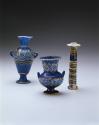
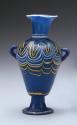
Cosmetic Jar (Amphoriskos)
Period
New Kingdom Period
(Ancient Egyptian, 1550–1070 BCE)
Dynasty
Dynasty 18
(Ancient Egyptian, 1550–1295 BCE)
Place of OriginEgypt
Dateabout 1400-1350 BCE
DimensionsH: 4 3/4 in. (12.1 cm)
Mediumcore-formed glass
ClassificationGlass
Credit LinePurchased with funds from the Libbey Endowment, Gift of Edward Drummond Libbey.
Object number
1951.405
Not on View
DescriptionA footed amphoriskos with a medium blue ground and applied opaque white and yellow decoration. The vessel features a horizontal rim sloping obliquely outward with an almost pointed edge, a funnel-shaped neck, and an inverted piriform body that tapers to a convex, almost pointed bottom. It rests on a tall, outsplayed medium blue foot with a rounded edge. Two vertical loop handles of dark blue glass are applied to the shoulder. Decoration consists of an unmarvered opaque white thread at the rim edge and another wound spirally around the neck base. On the body, marvered threads of opaque yellow and white are tooled into a deep, irregular festoon pattern that transitions to a shallow festoon pattern near the middle. A yellow thread winds horizontally above the foot, and a white thread encircles the foot's edge.
Label TextBefore the invention of glassblowing, Egyptian artisans created vessels like this by winding trails of molten glass around a core of clay and dung. The surface was then smoothed ("marvered") against a stone slab, and contrasting colored threads were dragged with a tool to create the wave-like "festoon" patterns. This shape, called an amphoriskos, mimics large clay storage jars used for wine, but this miniature glass version was a luxury object intended for the dressing table of a royal or noble household. It likely held precious perfumed oils or scented unguents, kept sealed with a linen or wax stopper.Published ReferencesRiefstahl, Rudolf M., "Ancient and Near Eastern Glass," Toledo Museum of Art Museum News 4, no. 2, 1961, p. 27, ill.
Neuburg, Frederic, Ancient Glass, Toronto, 1962, rev. trans. of Antikes Glas, Darmstadt fig. 6.
Riefstahl, Rudolf M., "The Complexities of Ancient Glass," Apollo 86, 1967, p. 428, fig. 1.
Nolte, Birgit, Die Glasgefasse im alten Aegypten, Muncher Aegyptologische Studien, no. 14, Berlin, 1968, pp.; 101-104, no. 6, pl. 12.
The Toledo Museum of Art, Art in Glass: A Guide to the Glass Collections, Toledo, Ohio, 1969, p. 16, ill.
Jones, Dorothy-Lee, "The Toledo Museum's New Glass Gallery," The Glass Club Bulletin, no. 93/94, Mar-June 1970, p. 10, repr.
"Art in Glass," The Glass Industry 51, July 1970, p. 315, ill.
Gunther, Charles F., "How Glass Is Made," Toledo Museum of Art Museum News 15, no. 1, 1972, p. 14.
Grose, David F., "Ancient Glass," Toledo Museum of Art Museum News 20, no. 3, 1978, pp. 70-71, fig. 2.
Goldstein in Egypt's Golden Age 1982, p. 164, no. 177.
Grose, David F., "Innovation and change in ancient technologies: The anomalous case of the Roman glass industry," in High-technology Ceramics, Westerville, OH, 1986, p. 1, fig. 67.
Grose, David F., Early Ancient Glass: Core-Formed, Rod-Formed, and Cast Vessels and Objects from the Late Bronze Age to the Early Roman Empire, 1600 B.C. to A.D. 50, Hudson Hills Press in Association with the Toledo Museum of Art, New York, 1989, cat. no. 5, p. 59-60, repr. (col.) p. 40, drawing, p. 397.
The Toledo Museum of Art, Toledo Treasures, Toledo, 1995, p. 36 repr. (col.)
"Glassmaking 5000 B.C. -- present," ARTaFacts Magazine, vol. 9, no. 2, Oct/Nov 2005, repr. (col.) p.[2].
Page, Jutta-Annette, The Art of Glass: Toledo Museum of Art, Toledo, Ohio, Toledo Museum of Art, 2006, p. 18, repr. (col.) fig. 1A, p. 19.
Toledo Museum of Art, Toledo Museum of Art Masterworks, Toledo, 2009, p. 65, repr. (col.).
Peck, William H., Sandra E. Knudsen and Paula Reich, Egypt in Toledo: The Ancient Egyptian Collection at the Toledo Museum of Art, Toledo, Toledo Museum of Art, 2011, p. 60-61, repr. (col.) p. 61.
Exhibition HistoryBoston, Museum of Fine Arts; Houston, Houston Museum of Natural Science; Baltimore, Walters Art Gallery, Egypt's Golden Age: The Art of Living in the New Kingdom 1558-1085 -- B.C., no. 117, p. 164, repr.Cincinnati, Cincinnati Art Museum; Brooklyn, Brooklyn Museum, Mistress of the House, Mistress of Heaven: Women in Ancient Egypt, 1996-97, no. 23z, p. 83, repr. (col.).
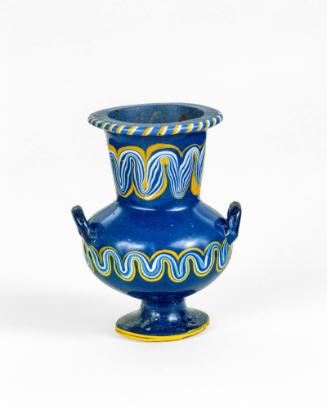

2nd through mid-1st century BCE
2nd through mid-1st century BCE

Late 6th through 5th century BCE
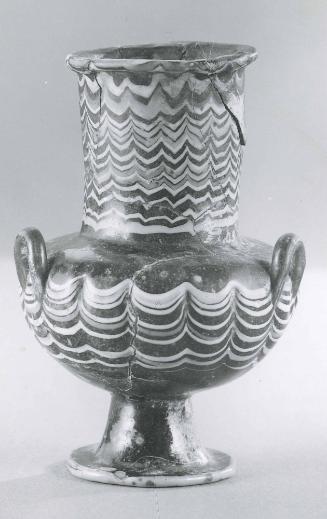
18th Dynasty (1550-1292 BCE), about 1412-1350 BCE
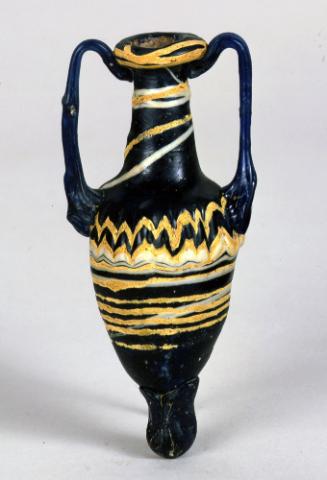
3rd century BCE

about 1350-1300 BCE

2nd through mid-1st century BCE

2nd-1st century BCE
Late 6th through 5th century BCE
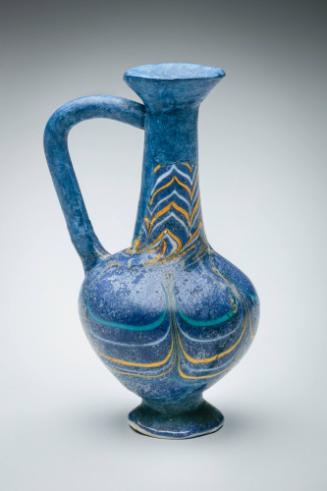
18th Dynasty (1550-1292 BCE), about 1400-1350 BCE

Membership
Become a TMA member today
Support TMA
Help support the TMA mission