

Mesopotamian-Style Necklace with Snakes and Lotus Pendants
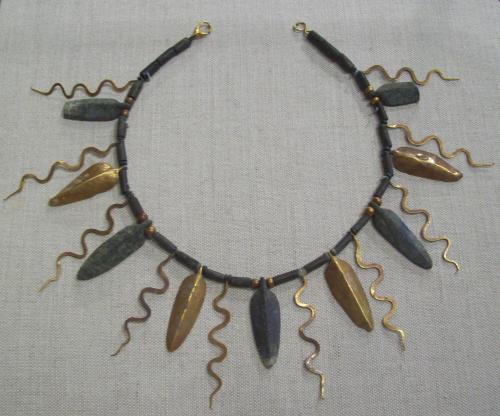

Mesopotamian-Style Necklace with Snakes and Lotus Pendants
Place of OriginPurportedly from Mesopotamia
DateLate 20th century (pastiche or forgery)
DimensionsL of necklace: 16 23/32 in. (42.5 cm); L of necklace with modern clasps: 17 29/32 in. (45.5 cm); L of a snake bead: 2 27/32 in. (7.2 cm); L of largest lapis bead: 1 31/32 in. (5 cm)
MediumGold and lapis lazuli
ClassificationJewelry
Credit LineGift of Thomas T. Solley
Object number
1991.109
Not on View
DescriptionA necklace composed of 81 elements strung axially. The composition alternates between cylindrical lapis lazuli beads and pendant elements. The pendants include ten gold undulating snake beads formed from wire, four gold lotiform (lotus-bud) beads, and five lapis lazuli lotiform beads. These major elements are interspersed with small, spherical gold beads
Label TextThis elaborate necklace combines beads of gold and lapis lazuli, a blue stone prized in the ancient world and imported from Afghanistan. The design features pendants in the shape of lotus buds—a motif likely influenced by Egyptian art—and undulating gold snakes radiating from the center. In Mesopotamian culture, snakes were often associated with fertility and healing. Scholars have debated the origins of this piece. While the gold and lapis lazuli materials show signs of great age, the unique combination of elements has no exact parallel in excavated archaeological sites. It is possible the necklace is a "pastiche," a modern re-stringing of ancient beads to create a new, elaborate design.Comparative ReferencesSee also Needler, W., Jewellery of the Ancient Near East, Toronto, 1966, p. 4.
cf. Maxwell-Hyslop, K.R., Western Asiatic Jewellery c. 3000-612 B.C., London, 1971, p. lxiv, l, 10, 30.
cf. Jewellery THrough 7,000 Years, London, The British Museum, 1976, p. 39.
cf. Tait, H. (ed.), Seven Thousand Years of Jewellery, London, The British Museum, 1986, p. 25.
cf. Kawami, T., Jewels of the Ancients: Selections from the Jill Sackler Collection of Ancient Near Eastern Jewellery, London, Royal Academy of Arts exhibition, May-June 1987, p. 1, no. 1.

Early Dynastic Period II-III, about 2600 BCE

19th Dynasty (1292–1189 BCE)

330-200 BCE

Late Roman - Coptic (4th-6th century CE)
25th–31st Dynasties (747–332 BCE)

mid 18th century
18th–19th Dynasties (1550–1189 BCE)

mid 18th century
4th century - 7th century CE
about 1865

Membership
Become a TMA member today
Support TMA
Help support the TMA mission