

Black-glazed Water Jar (Hydria) with Applied Myrtle Wreath
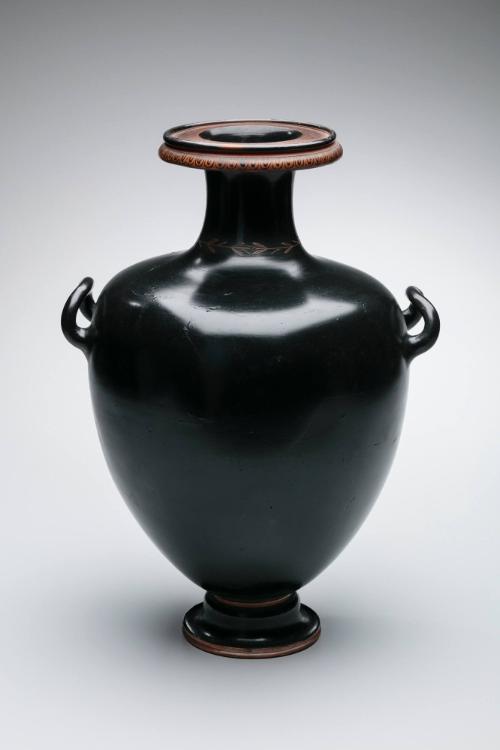


Black-glazed Water Jar (Hydria) with Applied Myrtle Wreath
Place of OriginGreece, Athens
Dateabout 360 BCE
DimensionsH: 16 in. (40.6 cm); Diam (at widest point): 9 1/4 in.
MediumWheel-thrown earthenware with black slip and applied color
ClassificationCeramics
Credit LinePurchased with funds from the Libbey Endowment, Gift of Edward Drummond Libbey
Object number
1969.372
On View
Toledo Museum of Art (2445 Monroe Street), Gallery, 02, Classic
DescriptionThis vessel is a hydria of the kalpis type, characterized by a continuous curve from the neck to the body. It features three handles: two horizontal handles curving upward on the shoulders for lifting, and one vertical handle attached to the neck and shoulder for pouring. The vessel rests on an ogive foot separated from the body by a groove. The surface is coated in a lustrous black slip, with the exception of the plastic ring on the lip and the groove above the foot. The rim is flat with an overhanging molding decorated with egg-and-dart motifs. Encircling the base of the neck is a delicate wreath of myrtle leaves and berries, created using the barbotine technique (applied clay slip). Traces of red pigment (miltos) are visible on the underside of the lip edge and the groove, and the wreath was likely originally gilded or painted to resemble gold.
Label TextThough made of clay, this elegant water jar was designed to imitate the luxury of precious metal. The lustrous black surface mimics the appearance of tarnished silver, which was highly enlarged in antiquity. The delicate wreath of myrtle leaves and berries around the neck was created using the barbotine technique—applying thick slip in relief—and was originally painted red or gilded to simulate a gold necklace or applied jewelry. While not an object for the average household, this ceramic vessel offered a more affordable alternative to the solid silver or bronze vessels used by the wealthy elite of Athens. The shape is a kalpis, a specific type of hydria featuring a continuous curve from the lip to the foot and three handles: two for lifting and one for pouring.Published ReferencesMünzen und Medaillen AG, Basel, Auktion 40, 13 Dec. 1969, no. 121, p. 77, repr.
Luckner, Kurt T., "Greek vases: shapes and uses," Toledo Museum of Art Museum News, vol. 15, no.3, p. 68, 70, repr. fig. 10.
Boulter, Cedric G., and Kurt T. Luckner, Corpus vasorum antiquorum: Toledo Museum of Art, U.S.A. Fasc. 17, Toledo, 1976, p. 38, repr. pl. 59 and 60,2.
Comparative ReferencesSee also Pollak, Ludwig and Antionio Munoz, Pieces de Choix de la COllection du Comte Gregoire Stroganoff a Rome, Rome, 1912, vol. 1, p. 62, pl. XLIII, no. 2.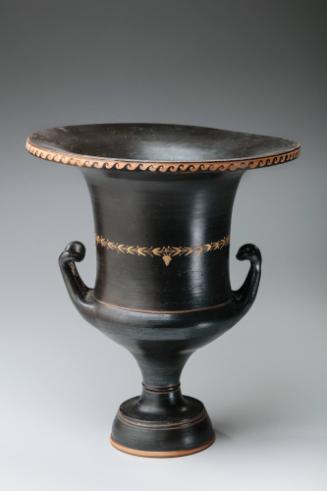
about 330-320 BCE

about 480 BCE

Workshop of the potter Nikosthenes
about 520 BCE


The Acheloos Painter, Leagros Group
about 510-500 BCE
250-175 BCE


1st-2nd century CE
Probably mid-1st century or earlier
Probably late 1st century BCE to early 1st century CE
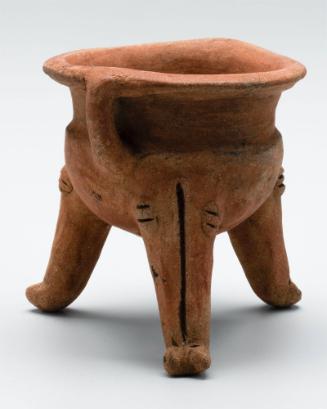
800-1500
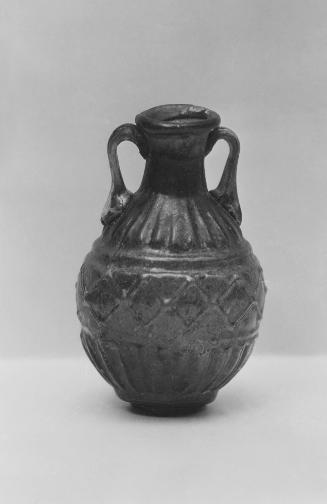
Probably second half of the 1st century

Membership
Become a TMA member today
Support TMA
Help support the TMA mission