

Bead (Spindle Whorl)
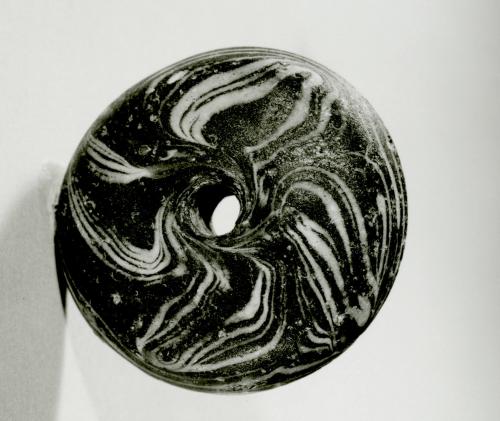

Bead (Spindle Whorl)
Place of OriginLikely Germany, reportedly from Bingen
Date6th - 7th century CE
DimensionsDiam: 1 3/4 in. (4.5 cm)
MediumTooled glass
ClassificationGlass
Credit LineGift of Gawain McKinley
Object number
1977.20
Not on View
DescriptionA large, discoid glass bead with a pear-shaped profile and a slightly concave base. The glass matrix appears opaque black but is likely a dense, dark green. It is decorated with an opaque, moderate yellow-green thread that has been trailed onto the surface and "combed" (dragged) to create a quadruple feather or festoon pattern (Zickzackmuster). The central perforation is cylindrical and drilled or tooled.
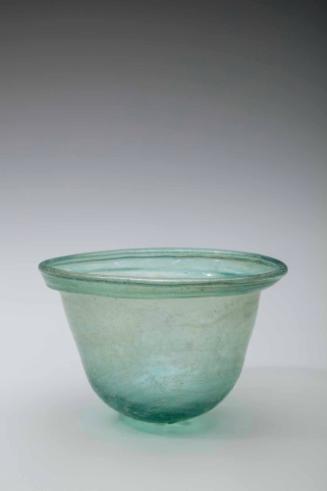
Label TextThis object belongs to a group of glass vessels and ornaments reportedly found in a single Frankish grave at Bingen, a settlement along the Rhine west of Mainz. The group includes two palm cups (1977.11, 1983.86), a gaming piece (1981.56), and two beads (1977.20, 1981.55). In the sixth and seventh centuries this region formed part of the Merovingian kingdoms, whose elite communities buried their dead with ornaments and vessels that marked identity, status, and regional taste.Published ReferencesGrose, David F., "Ancient Glass," Toledo Museum of Art Museum News, vol. 20, no. 3, 1978, p. 89, repr. fig. 32.
Effros, Bonnie, "Art of the 'Dark Ages': Showing Merovingian Artifacts in North American Public and Private Collections," JOURNAL OF THE HISTORY OF COLLECTIONS, vol. 17, no. 1, 2005, p. 110, no. 100.
5th-4th century BCE
6th - 7th century CE

about 400-100 BCE
2nd-5th century CE
1st century CE
1st century CE (or modern?)

Unidentified
Predynastic Period, Naqada I–II, about 3800–3300 BCE
Probably 8th century BCE

2nd-5th century CE

2nd-1st century BCE
1st century CE
1st century CE
Related Object/Related Object

Membership
Become a TMA member today
Support TMA
Help support the TMA mission