

Wine Jug (Oinochoe) with Wild Goats



Wine Jug (Oinochoe) with Wild Goats
Place of OriginTurkey, reportedly from Damlıboğaz (ancient Hydai)
Date600-550 BCE
DimensionsH: 12 11/16 in. (32.3 cm); Max Diam: 10 5/8 in. (27.0 cm); Diam (foot): 4 23/32 in. (12.0 cm)
MediumWheel-thrown, slip-decorated earthenware
ClassificationCeramics
Credit LinePurchased with funds from the Libbey Endowment, Gift of Edward Drummond Libbey
Object number
1971.2
Not on View
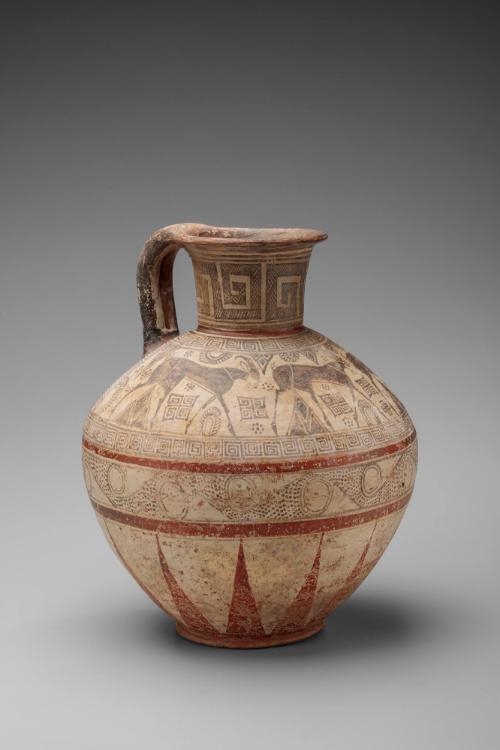
DescriptionThis round-mouthed pitcher (oinochoe) features a pale slip ground decorated with black-to-brown glaze and added red details. The vessel rests on a ring foot and has a single vertical handle attached to the rim. The primary decorative frieze on the shoulder displays a procession of grazing wild goats (agrimi) moving to the right, characterized by elongated bodies, small heads, and legs drawn as if walking on the tips of their hooves. Filling ornaments, including rosettes and geometric shapes, crowd the background of the animal frieze. Below this, a distinctive and unusual band of dot-filled spirals (or "running dog" pattern) encircles the belly. The lower body features a zone of rays rising from the foot. A large red cross is painted on the underside of the foot (dipinto).
Label TextThe vessel exhibits stylistic features characteristic of pottery from the region of Caria in modern-day Turkey, decorated in the so-called "Wild Goat Style." Originating around the mid-7th century BCE and named for its characteristic depictions of wild goats and other animals, this style was practiced in East Greek workshops, including those in Caria. The Wild Goat Style is characterized by silhouetted animal figures (primarily goats, though other animals appear) arranged in horizontal bands across the vessel. These animals are often depicted in profile, in movement—usually grazing or walking—set against geometric patterns like spirals, dots, and triangles. This vase has been repeatedly associated with a large group of vases attributed to a necropolis at Damlıboğaz (ancient Hydai), near Mylasa, but this association remains unverified.Published ReferencesBielefeld, Erwin, Kunstwerke der Antike [gallery booklet], Frankfurt, Galerie für Griechische, Römische und Byzantinische Kunst [Mohammad Yeganeh], 1970, pp. 7–8, ill. on p. 4.
"La Chronique des Arts," Gazette des Beaux-Arts, vol. 83, no. 1261, Feb. 1974, p. 99, repr.
"Recent Accessions of American and Canadian Museums," Art Quarterly, vol. 37, no. 1, spring 1974, pp. 98, 107, repr.
Boulter, Cedric G., and Kurt T. Luckner, Corpus Vasorum Antiquorum, Toledo Museum of Art, fasc. 2, U.S.A. fasc. 20, Mainz, 1984, pp. 4-5, pls. 67, 68.1. Cook, Robert M., “A Carian Wild Goat Workshop,” Oxford Journal of Archaeology, vol. 12, 1993, pp. 112–113.
Cook, Robert M., “A List of Carian Orientalizing Pottery,” Oxford Journal of Archaeology, vol. 18, no. 1, 1999, pp. 80–82, no. 7.
Fazlioglu, Ismail, “Damlıboğaz Finds: Inland Carian Archaic Pottery and Related Regions,” in Rumscheid, Frank (ed.), Die Karer und die Anderen: Internationales Kolloquium an der Freien Universität Berlin, 13. bis 15. Oktober 2005, Bonn, Verlag Dr. Rudolf Habelt GmbH, 2009, p. 470, n. 23.
Comparative ReferencesSee also Bielefeld, E., Kustwerke der Antike, Frankfurt, 1970, p. 7, no. 4.cf. Gercke, P., Funde aus der Antike Sammlung Paul Dierichs Kassel, Kassel, 1981, especially no. 7, p. 37.
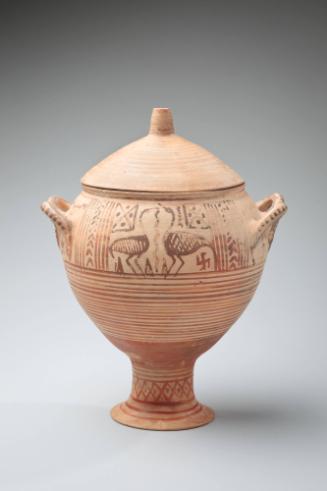
about 700 BCE
750-650 BCE

about 1740
about 1525-1550


1375-1300 BCE

Membership
Become a TMA member today
Support TMA
Help support the TMA mission