

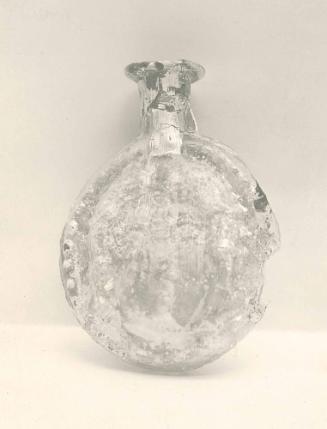
Jug in the Shape of the Head of a Woman or Dionysos
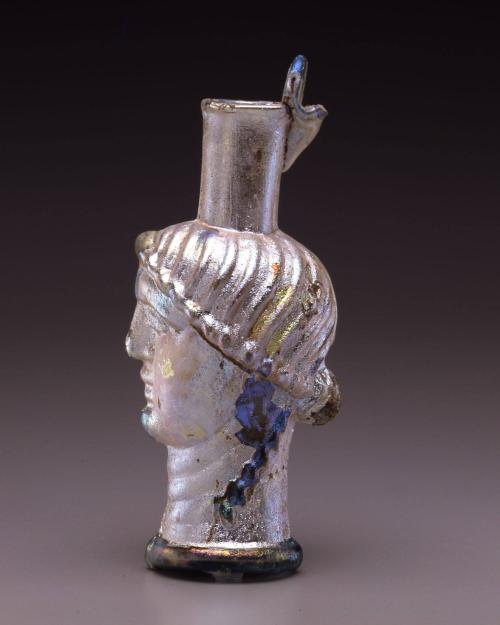


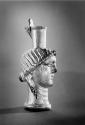

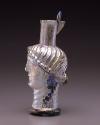
Jug in the Shape of the Head of a Woman or Dionysos
Place of OriginSyro-Palestinian, perhaps made in Sidon
Date1-50 CE
DimensionsH: 4 3/8 in. (11.0 cm); H without thumbrest: 3 15/16 in. (10 cm); H body: 2 13/16 in. (7.2 cm); Base diam: 1 1/4 in. (3.2 cm); rim diam: 13/16 in. (2.1 cm)
MediumMold-blown glass.
ClassificationGlass
Credit LinePurchased with funds from the Libbey Endowment, Gift of Edward Drummond Libbey
Object number
1967.8
Not on View
DescriptionThe vessel is a jug with a tall cylindrical neck and a body in the shape of a female head on a tall cylindrical neck. It is made of medium thin, transparent pale blue green glass (5 BG 7/2). The body and neck were mold-blown into a two-part mold of two vertical sections, resulting in a continuous mold seam that runs through the center of the face, back of the head, and across the underside of the base. The relief is crisp. The head has deep-set almond-shaped eyes, a narrow projecting nose, short horizontal lips slightly parted, and a very heavy protruding chin. The neck features three horizontal rings, known as Venus rings. Teardrop-shaped earrings hang from the visible ear lobes. The hair is worn in a severe style, parted in the middle with a nodus (knot/bun) over the center of the forehead, drawn down in wavy locks to a roll that frames the face, and tied in a chignon at the nape. Corkscrew curls emerge from the chignon and are drawn diagonally forward down the neck. The handle is missing, with only the point of application and a vertical thumbrest preserved at the rim. The exterior is covered with a very thick, flaking layer of silver iridescence
Label TextThis striking glass jug is one of the earliest known examples of mold-blown head-shaped vessels from the Roman world. Crafted in the Syro-Palestinian region, perhaps in the city of Sidon, it is a testament to the new glassblowing technology that allowed for the mass production of relief-decorated containers. The vessel's elaborate hairstyle, featuring a nodus (knot) over the forehead and a chignon at the nape, strongly resembles the coiffure of Livia, the wife of Emperor Augustus. However, scholars note that the jug’s facial features do not match Livia's official portraits. It may instead represent Livia as a personification of the goddess Hera/Juno, an interpretation supported by the decorative Venus rings on the neck.Published ReferencesSangiorgi, g., Collezione di vetri antichi dalle origini al V secolo d. Chr. (Milan and Rome 1914), no. 107, pl. XXII.
"Treasures for Toledo," Toledo Museum of Art, Museum News, New Series, Vol. 12, no. 4, Winter 1969, repr. p. 92.
The Toledo Museum of Art, Art in Glass: A Guide to the Glass Collections, Toledo, Ohio, 1969, 24, ill.
Grose, David F., "Ancient Glass," Toledo Museum of Art, Museum News vol. 20, no. 3 (1978), p. 82, fig. 19.
Stern, E. Marianne, Roman Mold-blown Glass: The First through Sixth Centuries, 1995, no. 138, p. 216-219, color pl. 22, p. 60.
Stern, E. Marianne, "A glass head flask featuring Livia as Hera?," in Kontinos: Festschrift für Erika Simon, Mainz, 1992, pp. 394-399, pl. 81, 2 & 3. [copy of article in Reg. Off & Library].
Page, Jutta-Annette, The Art of Glass: Toledo Museum of Art, Toledo, Ohio, Toledo Museum of Art, 2006, p. 40, repr. (col.) p. 41.
Toledo Museum of Art, Toledo Museum of Art Masterworks, Toledo, 2009, p. 81, repr. (col.).

about 450-430 BCE

Late 2nd or 1st century BCE

Second half of the 1st century CE

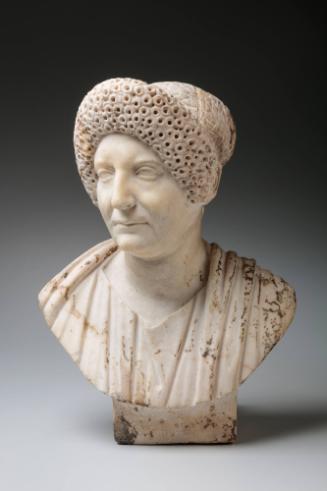
c. 90 CE
Perhaps late first or 2nd century

Probably first half of the 1st century

Late 19th century

Late 2nd to early 3rd century CE
Second half of the 1st century CE

Membership
Become a TMA member today
Support TMA
Help support the TMA mission