

Unguent Bottle (Alabastron)

Unguent Bottle (Alabastron)
Place of OriginEastern Mediterranean, possibly from Rhodes, Greece
DateLate 6th - 5th century BCE
DimensionsH: 4 5/16 in. (11 cm); Rim Diam: 1 7/16 in. (3.7 cm); Diam: 1 3/16 in. (3 cm)
MediumCore-formed glass
ClassificationGlass
Credit LineGift of Edward Drummond Libbey
Object number
1923.339
Not on View
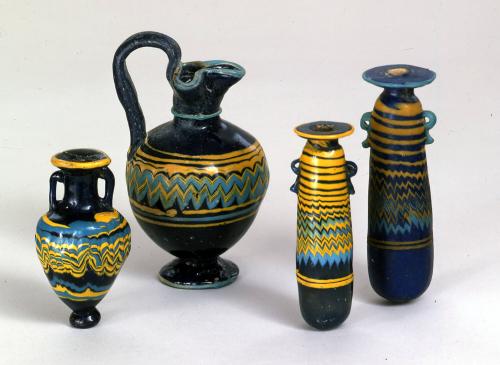
DescriptionThis small ancient bottle, known as an alabastron, was made from dark blue glass and decorated with colored threads. It has a cylindrical shape and two small handles. The decoration includes a zigzag pattern in yellow and turquoise, and spiral bands around the body.
Published ReferencesGrose, David F., Early Ancient Glass: Core-formed, Rod-Formed, and Cast Vessels and Objects from the Late Bronze Age to the Early Roman Empire, 1600 B.C. to A.D. 50, New York, Hudson Hills Press in association with the Toledo Museum of Art, 1989, cat. no. 70, p. 135, repr. (col.) p. 96.Late 6th through 5th century BCE

Late 6th through 5th century BCE
Late 6th - 5th century BCE

5th century BCE
Mid-4th through early 3rd century BCE
Late 6th through 5th century BCE
Late 6th through 5th century BCE
3rd through 2nd century BCE

Mid-4th through early 3rd century BCE

Probably 6th Century BCE
2nd through mid-1st century BCE

Membership
Become a TMA member today
Support TMA
Help support the TMA mission