

Wine Pitcher (Oinochoe) with Amazon Head
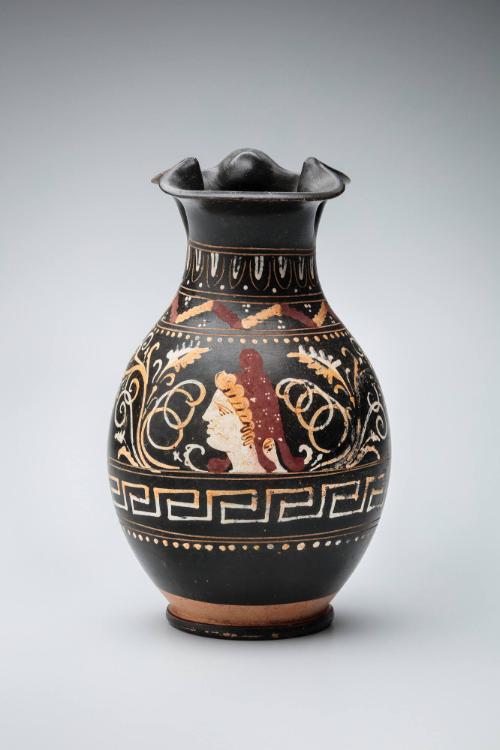

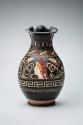
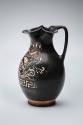


Wine Pitcher (Oinochoe) with Amazon Head
Artist
Toledo Painter
(Greek)
Place of OriginItaly, Apulia, perhaps Ruvo di Puglia
Dateabout 330-320 BCE
DimensionsOverall: 7 3/4 × 4 3/8 × 4 3/4 in. (19.7 × 11.1 × 12.1 cm)
Base Diam: 2 3/4 in. (7 cm)
Rim: 3 1/2 × 3 1/4 in. (8.9 × 8.3 cm)
Base Diam: 2 3/4 in. (7 cm)
Rim: 3 1/2 × 3 1/4 in. (8.9 × 8.3 cm)
MediumWheel-thrown earthenware with polychrome slip decoration on a black slip ground
ClassificationCeramics
Credit LinePurchased with funds from the Libbey Endowment, Gift of Edward Drummond Libbey
Object number
1973.5
On View
Toledo Museum of Art (2445 Monroe Street), Gallery, 02, Classic
DescriptionThe vase is intact, though it has a slight dent in the shoulder in front of the Amazon's hair and some loss of the added white slip. The decoration is executed in the Gnathia technique, using added white, red, and ochre slip on a black slip ground, and is confined to the front of the vessel. The main panel features the head of an Amazon facing left, set between elaborate floral designs. Her face is rendered in added white, with features and hair detailed in ochre. She wears a red Phrygian cap decorated with triplets of white dots. The neck is decorated with an upper band of incised egg-and-dot and a lower zigzag band of alternating red and ochre, filled with white dots. The main panel is bordered by bands of white dots washed with ochre. Below the main panel is a meander pattern, its upper half washed in ochre, bordered by incised lines. The vessel has a torus foot, which is slipped, and is set off from the body by a reserved (un-slipped) band. The underside of the foot is also reserved.
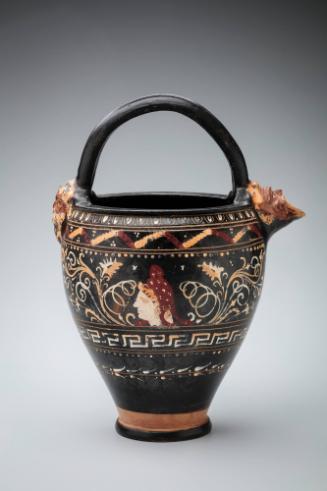
Label TextThis wine jug, or oinochoe, was crafted in Magna Graecia (“Great Greece”), the region of southern Italy colonized by Greek settlers beginning in the 8th century BCE. These Greeks lived alongside native Italic peoples, such as the Apulians, creating a vibrant, multicultural society. This jug was made for this mixed market, blending Greek artistic style with local Italic beliefs. It is one of three matching vases (1973.5, 1973.6, 1973.7) in the museum’s collection that are so distinctive in their style that they became the "namesake vases" for the previously unknown ancient artist now known as the Toledo Painter.
The head in the Phrygian cap was a deliberately ambiguous image. A Greek might see it as a mythical Amazon warrior, while an Italic viewer might see a hero, or a deity like Attis or Orpheus. This purposeful flexibility allowed the vase to hold deep meaning for people from different backgrounds. Like most South Italian vases, this jug was ultimately a funerary offering. It was used in rituals honoring the dead and then placed in an elite tomb to accompany the deceased, expressing a shared cultural hope for a blissful and eternal afterlife.
Published ReferencesWittmann, Otto, ed., "Treasures for Toledo," Toledo Museum of Art Museum News, vol. 19, nos. 2 and 3, 1976, p. 48, repr.Green, J.R., "Gnathia Vases by The Toledo Painter," Toledo Museum of Art Museum News, vol. 22, no. 2, 1980, pp. 26-36, fig. 2.
Luckner, Kurt T., The Art of South Italy: Vases from Magna Graecia, Richmond, 1982, p. 269, no. 128.
Boulter, Cedric G., and Kurt T. Luckner, Corpus Vasorum Antiquorum, Toledo Museum of Art, fasc. 2 [U.S.A., fasc. 20], Mainz, 1984, pp. 25-6, pl. 108.1-2. Kossatz-Deissmann, Annelise. "Eine Neue Phrygerkoph-Situla des Toledo-Malers," Archaölogisches Anzeiger, 1990, p 511, n. 176.
Exhibition History"The Art of South Italy: Vases from Magna Graecia" The Virginia Museum of Fine Arts, Richmond (May 12-Aug. 8, 1982); Philbrook Art Center, Tulsa (Nov. 20, 1982 - Jan. 9, 1983); The Detroit Institute of Arts (Feb. 7 - April 10, 1983); no. 128.
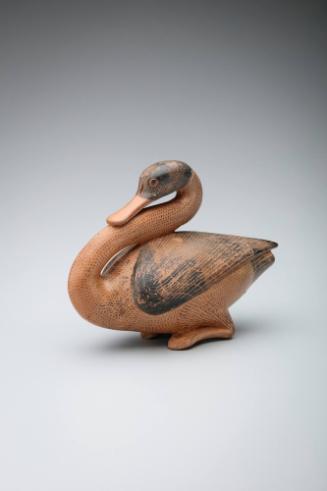
about 575 BCE

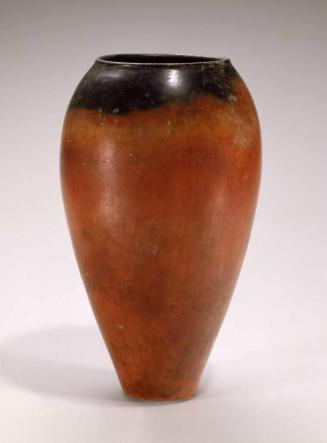
Predynastic Period, Naqada I–II, about 3400–3200 BCE


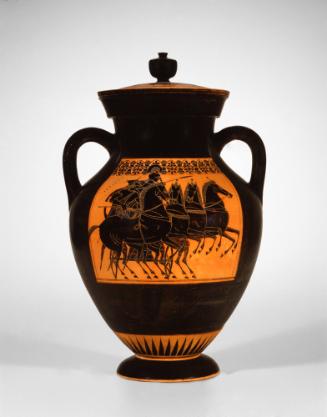
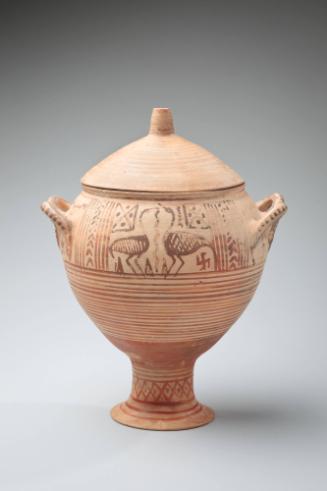
about 700 BCE

late 15th century

Membership
Become a TMA member today
Support TMA
Help support the TMA mission