

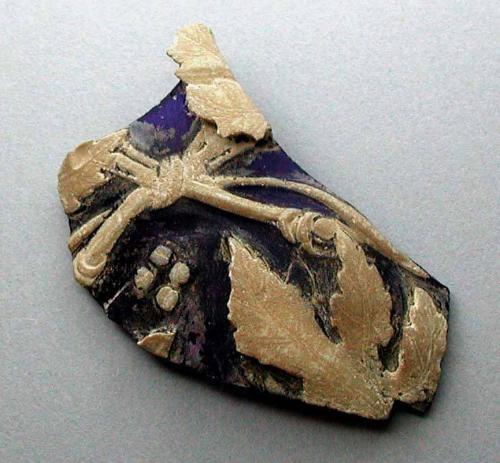
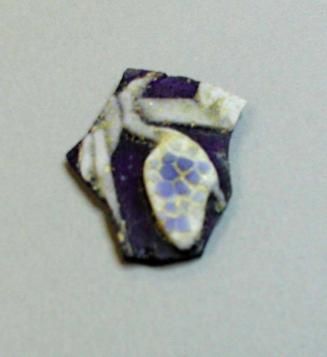
High-Relief Cameo Glass Fragment with Grapevines

High-Relief Cameo Glass Fragment with Grapevines
Place of OriginItaly, likely Rome or Bay of Naples
Dateabout 15 BCE - 25 CE (Roman, Augustan)
DimensionsL: 2 1/2 in. (6.2 cm); W: 1 3/8 in. (3.3 cm)
MediumCameo glass.
ClassificationGlass
Credit LineGift of Edward Drummond Libbey
Object number
1923.1599
Not on View
DescriptionThis curved fragment (6.2 × 3.3 cm) from a cameo glass vessel preserves botanical decoration in white over translucent cobalt blue. The design includes knotted fillets, grape leaves, acanthus foliage, and grape or berry clusters, rendered in high undercut relief. The relief is strongly undercut—possibly to 0.4 cm—but coarsely executed. Lines forming the leaves and knots are sharply incised, almost like being drawn in a single stroke, and lack plasticity. One leaf shows blue rising nearly to the surface, likely due to uneven white glass distribution. The background was irregularly cut, with random polishing marks and no evident surface smoothing. The object has been weathered and iridesced overall.
Label TextThis fragment of a Roman cameo glass vessel preserves part of a grapevine motif in white glass over a cobalt blue background. Knotted fillets and deeply undercut leaves wrap around the curved surface, alongside grape clusters and acanthus motifs. The fragment's technique is bold and graphic, with sharply incised outlines. Similar decorative styles appear on celebrated cameo vessels from Pompeii, such as the Auldjo Jug (now in the British Museum) and the Blue Vase (now in the Museo Archeologico Nazionale di Napoli). Acquired by Edward Drummond Libbey in 1919 from the family of Thomas Hulse Curtis. The Curtis collection was largely acquired in the 1890s from Charles Caryl Coleman, an American artist who resided first in Rome and later on the island of Capri. This collection history strongly suggests a findspot in or around Rome or the Bay of Naples.Published ReferencesRoberts, Paul, William Gudenrath, Veronica Tatton-Brown, and David Whitehouse, Roman Cameo Glass in the British Museum, London, British Museum Press, 2010, p. 47.
Comparative Referencescf. Froehner, Wilhelm, Collection Julien Gréau: Verrerie antique, émaillerie et poterie appartenant à M. John Pierpont Morgan, Paris, 1903, vol. 1, no. 573, p. 83, pl. 59.8.
Tang Dynasty (618-907)
Tang Dynasty (618-907)

about 15 BCE - 25 CE (Roman, Augustan)

First half of 1st century

Probably 3rd century

Probably 3rd century

Probably 3rd century
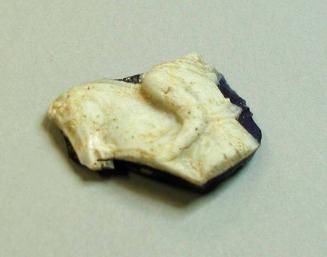
about 15 BCE - 25 CE (Roman, Augustan)
19th century?
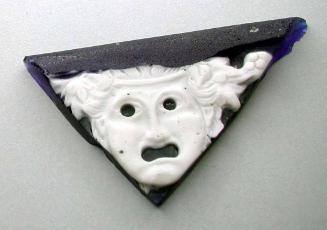
Roman or 19th century?
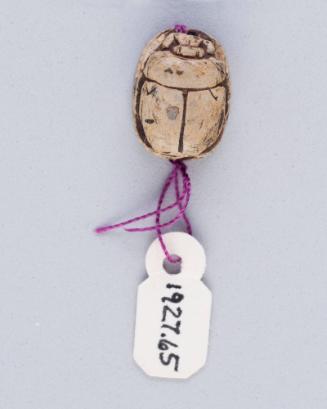
18th Dynasty (1550-1292 BCE), about 1400 BCE

Probably 3rd Century CE

Membership
Become a TMA member today
Support TMA
Help support the TMA mission