

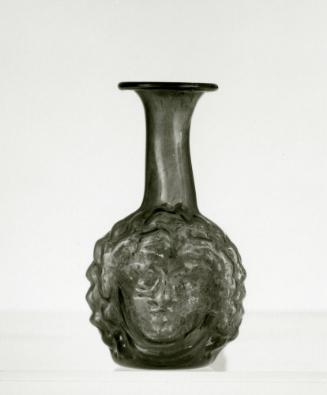
Flask in the Shape of a Head of Dionysus
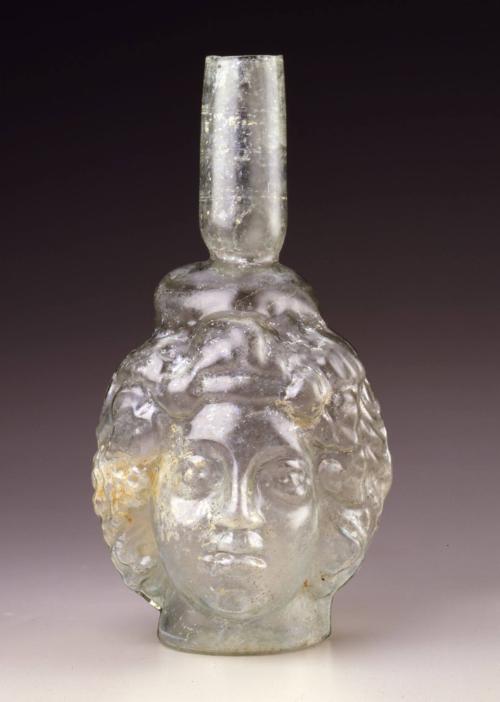

Flask in the Shape of a Head of Dionysus
Place of OriginLikely Syria or Turkey
Dateabout 200 CE
DimensionsH: 16.7 cm (6 9/16 in.); Max Diam: 8.5 cm (3 3/8 in.)
MediumColorless glass; blown in a full-size, three-part mold of two vertical sections and a separate disk-shaped base section
ClassificationGlass
Credit LinePurchased with funds from the Libbey Endowment, Gift of Edward Drummond Libbey
Object number
1979.53
Not on View
DescriptionA translucent, pale natural green glass vessel blown into a three-part mold comprising two vertical sections and a separate disk-shaped base section. The body forms the head of a beardless youth with idealized, fleshy features, heavy brows, and almond-shaped eyes with recessed pupils. The figure wears an ivy wreath with berries at the temples and a fillet across the forehead. The hair is rendered in large tufts around the face and flat, irregular vertical ridges on the back. The neck is cylindrical, free-blown, and finished with wheel-cut horizontal bands and a ground rim. The underside of the foot is concave and features a rare mold-blown intaglio design of a Medusa mask (Gorgoneion) with a bow-shaped ornament below the chin.
Label TextThis flask takes the shape of a beautiful youth wearing a wreath of ivy and berries, attributes of Dionysos, the Greek god of wine (known to Romans as Bacchus). Scholars suggest the features may also resemble Antinous, the beloved companion of the Emperor Hadrian, who was deified after his death and often depicted in the guise of Dionysos.
A hidden detail lies beneath the vessel: a distinguishing feature of this flask is the intaglio Medusa mask on the underside of the base. Such basal decorations are extremely rare on head flasks; only two other close parallels with this specific base design are recorded (one in the National Museum of Wales, Cardiff, and one in the British Museum). The presence of the Medusa, a protective symbol, suggests the vessel may have held precious oils or liquids requiring ritual or superstitious safeguarding.
Published ReferencesCatalogue of the Constable-Maxwell Collection of Ancient Glass, Sotheby-Parke-Bernet and Co., London, June 4-5, 1979, p. 71, no. 113.Toledo Museum of Art Museum News, vol. 21, no. 4, 1979, p. 79.
Journal of Glass Studies, vol. 22, 1980, p. 89.
Stern, E. Marianne, Roman Mold-Blown Glass: The First through Sixth Centuries, 1995, pp. 230-232, no. 148, color pl. 25.
Page, Jutta-Annette, The Art of Glass: Toledo Museum of Art, Toledo, OH, Toledo Museum of Art, 2006, p. 40, fig. 13B, repr. (col.) p. 41.
Peck, William H., Sandra E. Knudsen and Paula Reich, Egypt in Toledo: The Ancient Egyptian Collection at the Toledo Museum of Art, Toledo, Toledo Museum of Art, 2011, p. 102, repr. (col.).
Exhibition HistoryToledo Museum of Art, Out of Sight, June 18-Aug. 29, 2010 (no cat.).Toledo Museum of Art, The Egypt Experience: Secrets of the Tomb, October 29, 2010-January 8, 2012.

Second half of the 1st century CE
Probably first half of 1st century
Probably first half of 1st century
Second half of the 1st century CE
Mid-1st century

First half of the 1st century

Probably second quarter of the 1st century

Roman or 19th century?


Probably mid- to second half of 1st century

Membership
Become a TMA member today
Support TMA
Help support the TMA mission