
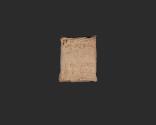
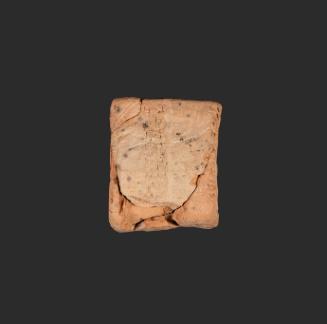
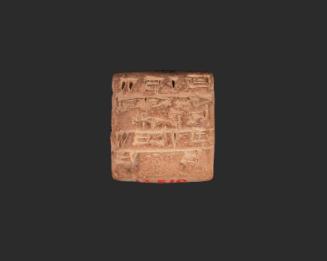
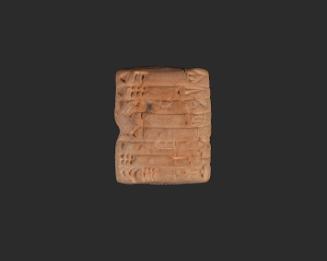
Sumerian Clay Tablet with Cylinder Seal Impression


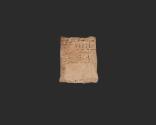
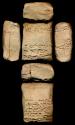
Sumerian Clay Tablet with Cylinder Seal Impression
Place of OriginIraq, Girsu (modern Tello)
Date2046 BCE
DimensionsH: 2 1/16 in. (5.2 cm); W: 1 11/16 in. (4.3 cm); Depth: 7/8 in. (2.2 cm)
MediumClay
ClassificationUtilitarian Objects
Credit LineMuseum Purchase
Object number
1930.197
Not on View
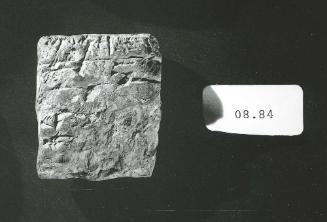
DescriptionRectangular clay tablet enclosed within a sealed clay envelope.
Inscribed in Sumerian cuneiform
. Contains administrative text recording barley distribution
. Features cylinder seal impression.
Label TextThis clay tablet, found in Girsu, was once enclosed in a sealed envelope, securing a record of barley distribution during the first year of King Amar-Sin’s reign (Ur III period, ca. 2046 BC). The grain came from a field linked to Ninmar, a goddess of cattle and oaths. The transaction was overseen by temple officials and sealed by Ur-Lama, son of Egišgigir the brewer—ensuring accountability in an economy where barley meant both sustenance and power.Published ReferencesMaggs Bros., The Art of Writing, 2800 B.C. to 1930 A.D.: Illustrated in a Collection of Original Documents Written on Vellum, Paper, Papyrus, Silk, Linen, Bamboo, or Inscribed on Clay, Marble, Steatite, Jasper, Haematite, Matrix of Emerald and Chalcedony, Exhibiting Forty Styles of Scripts in the Languages of Europe, Asia and Africa. Catalogue No. 542. London: Maggs Bros., 1930, page 10, lot no. 9.
Van der Meiroop, Marc, "Cuneiform Tablets from The Toledo Museum of Art," Revue d'Assyriologie, no. 1, 1985, p. 18, 33, repr. p. 32. “RA 079, 032 25 Artifact Entry.” 2001. Cuneiform Digital Library Initiative (CDLI). December 20, 2001. https://cdli.ucla.edu/P128047. http://bdtns.filol.csic.es/catalogo_directo_new.php?numBDTS=028725 https://oracc.museum.upenn.edu/epsd2/P128047


about 2042 BCE


Old Akkadian period (ca. 2340–2200 BCE)


about 2040 BCE
Ur III Period (about 2100-2000 BCE)

Membership
Become a TMA member today
Support TMA
Help support the TMA mission