

Bead with Bearded Male Head
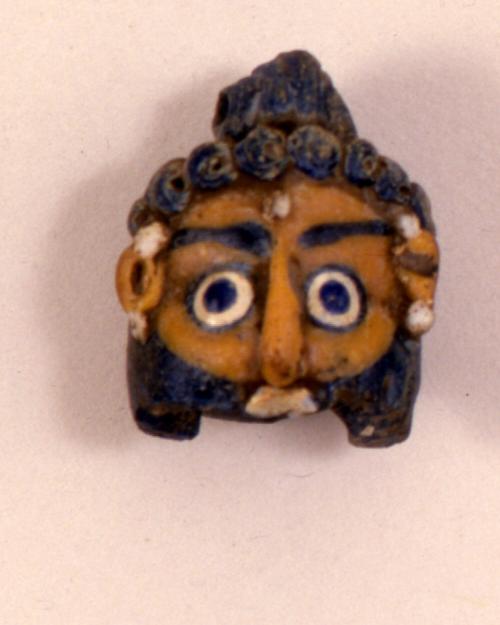

Bead with Bearded Male Head
Place of OriginTunisia, likely Carthage
Date5th or 4th century BCE
DimensionsL: 1 1/8 in. (2.9 cm); W: 7/8 in. (2.3 cm); Depth; 13/16 in. (2.1 cm)
MediumRod-formed; tooled and applied features and suspension ring.
ClassificationJewelry
Credit LinePurchased with funds from the Libbey Endowment, Gift of Edward Drummond Libbey
Object number
1976.56
Not on View
DescriptionPendant of a bearded male head. Dark blue ground with an opaque yellow face; dark blue spiraling ringlets applied separately across the forehead and vestiges of longer spiraling ringlets applied as a beard; dark blue vertical suspension ring; opaque yellow ears with opaque white earrings attached at the top and bottom of each ear; opaque white mouth; opaque white eyes outlined in dark blue with dark blue centers; a small opaque white protrusion at the center of the forehead. Cylindrical shape.
Label TextThese intricate glass pendants, produced centuries before the invention of glassblowing, demonstrate the skill of Phoenician artisans in the Eastern Mediterranean. Using a technique called rod-forming, glassmakers wound hot threads of colored glass around a metal core to sculpt minute details, such as the beard of a male head or the horns of a ram. The staring eyes and vibrant yellows and blues were not merely decorative; these objects functioned as apotropaic amulets, worn to ward off the "evil eye" and protect the wearer from misfortune. This specific group (1923.354A-S, 1976.54-1976.60) constitutes one of the most significant collections of its kind in the United States. Acquired from the Thomas E. H. Curtis collection, these pendants were identified by scholar Monique Seefried as originating primarily from the Syro-Palestinian coast (modern Lebanon and Israel) rather than Carthage (with the possible exception of 1976.56).Published ReferencesSeefried, Monique, Les pendentifs en verre sur noyau des pays de la Mediterranee antique, Collection do l'Ecole Francaise de Rome, no. 57, Rome, 1982, p. 103, no. C II 3.
Grose, David F., Early Ancient Glass: Core-Formed, Rod-Formed, and Cast Vessels and Objects from the Late Bronze Age to the Early Roman Empire, 1600 B.C. to A.D. 50, New York, Hudson Hills Press in association with the Toledo Museum of Art, 1989, cat. no. 44, p. 89, repr. (col.) p. 71.
Markoe, Glenn, "A nation of artisans," Archaeology, vol. 43, no. 2, Mar/Apr. 1990, p. 32, repr.

6th through 5th century BCE

Late 6th-3rd century BCE
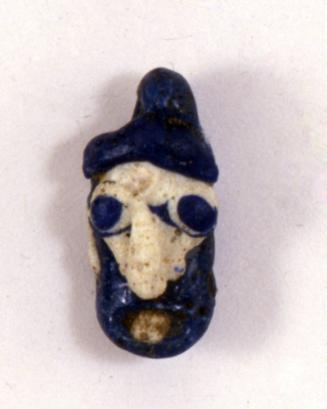
6th through 5th century BCE (possibly modern)
Late 6th - 3rd century BCE
6th-5th century BCE
3rd century BCE
3rd century BCE
3rd century BCE
3rd century BCE
3rd century BCE

Membership
Become a TMA member today
Support TMA
Help support the TMA mission