

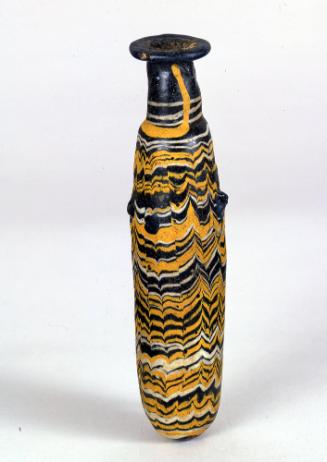
Unguent Bottle (Alabastron)

Unguent Bottle (Alabastron)
Place of OriginEastern Mediterranean
Date3rd-2nd century BCE
DimensionsH: 3 9/16 in. (9.1 cm); Diam: 7/8 in. (2.2 cm); Max Diam of body: 15/16 in. (2.4 cm)
Mediumglass
ClassificationGlass
Credit LineGift of Edward Drummond Libbey
Object number
1923.175
Not on View
DescriptionThis small alabastron has a blue ground with opaque yellow decoration. It features a narrow, uneven horizontal rim-disk with a rounded edge, a tall cylindrical neck that tapers slightly downward, a rounded shoulder, and a straight-sided cylindrical body that narrows subtly near the base. The bottom is shallow and convex, with one flattened side.
A marvered opaque yellow thread is attached at the edge of the rim-disk. It winds diagonally around the neck and in nearly horizontal lines above the shoulder before being tooled into a widely spaced feather pattern. This pattern is arranged in seven vertical panels that extend to the bottom of the vessel.
Manufactured using the core-forming technique, the vessel also includes an applied rim-disk and applied marvered threads.
Published ReferencesHayes, John W., Roman and Pre-Roman Glass in the Royal Ontario Museum, Toronto, 1975, pp. 9-10.
Grose, David F., Early Ancient Glass: Core-Formed, Rod-Formed, and Cast Vessels and Objects from the Late Bronze Age to the Early Roman Empire, 1600 B.C. to A.D. 50, New York, Hudson Hills Press in association with the Toledo Museum of Art, 1989, cat. no. 163, p. 167, drawing p. 407.
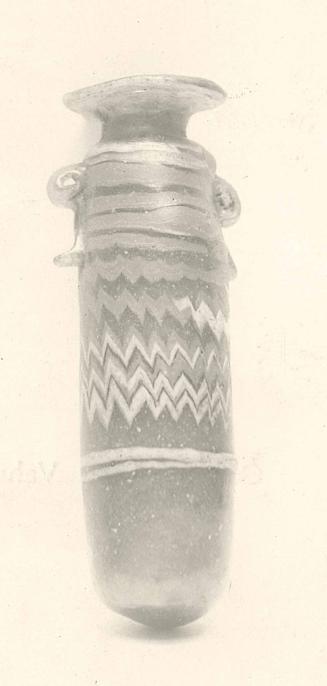
Late 6th through 5th century BCE

Late 6th through 5th century BCE
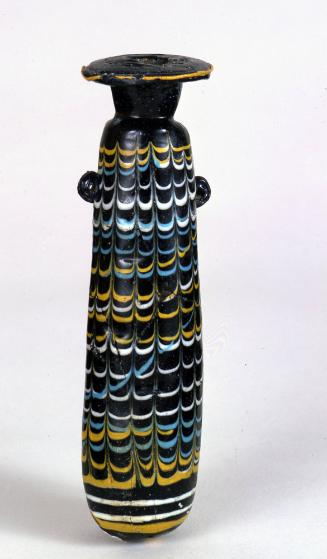
Mid-4th through early 3rd century BCE
Late 6th through 5th century BCE
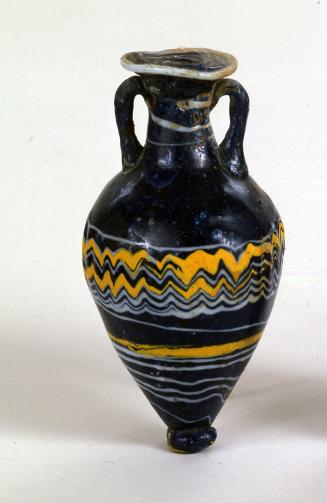
late 6th through 5th century BCE

5th century BCE
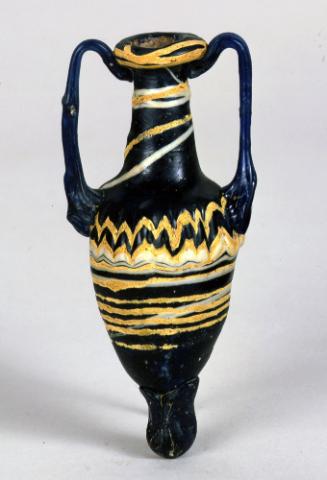
3rd century BCE
4th-3rd century BCE

5th century BCE
Mid-4th through early 3rd century BCE

Membership
Become a TMA member today
Support TMA
Help support the TMA mission