
Oxyrhynchus Papyrus (Toledo Treatise on Literary Composition, Part I)


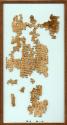
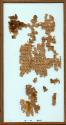
Oxyrhynchus Papyrus (Toledo Treatise on Literary Composition, Part I)
Place of OriginEgypt, excavated at Al-Bahnasa (ancient Oxyrhynchus)
DateRoman Period, 3rd century CE
Dimensionsoverall maximum as preserved in modern mount: 11 1/2 × 5 15/16 in. (29.2 × 15.1 cm)
overall approximate width of entire original document: 29 1/2 in. (74.9 cm)
overall approximate width of entire original document: 29 1/2 in. (74.9 cm)
MediumIndia ink on papyrus
ClassificationManuscripts
Credit LineGift of Edward Drummond Libbey
Object number
1915.45
Not on View
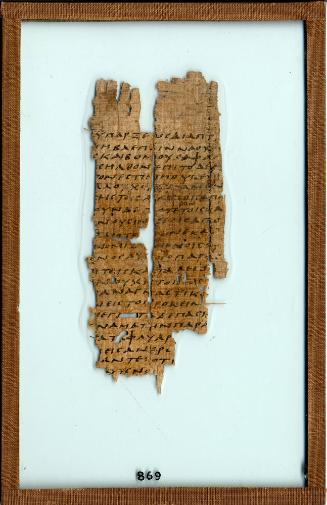
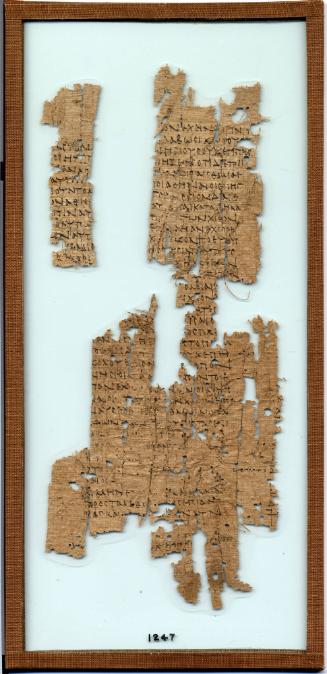
DescriptionGroup of papyrus fragments (P.Oxy. 1012, frs. 1–8) preserving early sections of a Greek prose treatise on literary composition and rhetorical style. Excavated from the Oxyrhynchus rubbish mounds, the text includes methodological remarks on prose structure and an extended evaluation of the orator Lysias, emphasizing clarity, propriety, and persuasion. Written in a clear literary hand on reused papyrus. These fragments form part of the same original roll as 1915.44, 1915.46, and 1915.47.
Label TextRecovered from the famous rubbish mounds of Oxyrhynchus in Egypt, this papyrus represents a unique survival of ancient literary scholarship. Among the ancient texts housed at the Toledo Museum of Art, this manuscript stands out for its importance. While many papyri preserve standard copies of famous texts or routine tax documents, this text is a unique work found nowhere else in the world. Although the author remains anonymous, internal references to scholars like Didymus of Alexandria suggest he was active shortly after the beginning of the Christian era. He demonstrates a profound command of the classics, citing a vast array of writers including Herodotus, Thucydides, Demosthenes, Epicurus, and Aristophanes.
The treatise is invaluable to global scholarship because it offers a rare, direct window into the "Atticist" controversy—a fierce intellectual movement in the Roman Empire dedicated to purging the Greek language of "modern" corruptions. The text covers a considerable diversity of topics, from systems of ethics and the suppression of facts in historical narratives to technical distinctions in word accents. However, the author is most notable for his bold refusal to accept the established canon. Acting as a rigorous gatekeeper, he launches a severe critique against the historian Xenophon. Although Xenophon was traditionally revered as a model of Attic purity, this critic attacks him for using "barbarous" vocabulary, providing crucial evidence that ancient critics were not passive readers, but active, opinionated scholars who debated the boundaries of their own culture.
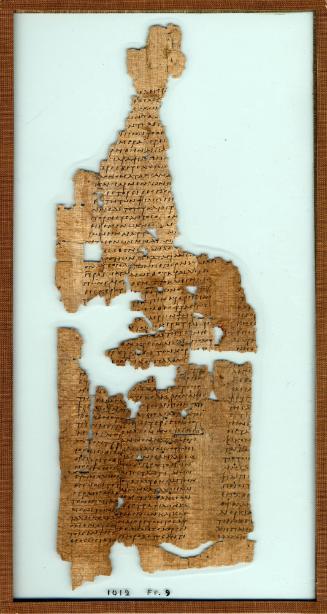
Originally a single continuous roll copied in the late 2nd or early 3rd century AD, the manuscript is now preserved in the Toledo Museum of Art’s collection as four distinct groupings of fragments (frs. 1–8 are 1915.45, fr. 9 is 1915.46, frs. 10–15 are 1915.44, and frs. 18–59 are 1915.47).
Published ReferencesGrenfell, Bernard Pyne, and Hunt, Arthur Surridge (eds.), The Oxyrhynchus Papyri, London, Egypt Exploration Fund, 1910, vol. VII, pp. 82–103, no. 1012.Piccirilli, Luigi, “Temistocle εὐεργέτης dei Corciresi,” Annali della Scuola Normale Superiore di Pisa. Classe di Lettere e Filosofia, vol. 3, 1973, pp. 317–355.
Fanan, Graziella, “Il lessico del P. Oxy. 1012,” Studi Classici e Orientali, vol. 26, March 1977, pp. 187–248.
Corpus dei papiri filosofici greci e latini, Florence, 1989, vol. I, pp. 152 -157, 244; vol. II, pp. 162, 214 -219.
Miner, Jess, and Michael De Brauw, “Androtion's Alleged Prostitution Contract: Aes. 1.165 and Dem. 22.23 in Light of P. Oxy. VII 1012,” Zeitschrift der Savigny-Stiftung für Rechtsgeschichte: Romanistische Abteilung, vol. 121, 2004, pp. 301–313.
Erbì, Margherita, “P.Oxy 1012 come testo d'erudizione,” in Esegesi letteraria e riflessione sulla lingua nella cultura greca, Pisa, Giardini Editori e Stampatori, 2006, pp. 127–157.
Del Corso, Lucio, “Lo ‘stile severo’ nei P.Oxy.: una lista,” Aegyptus, vol. 86, 2006, pp. 81–106, no. 13.
Vessella, Carlo, “Atticist Lexica and the Pronunciation of Greek,” CHS Research Bulletin, vol. 3, 2014, p. 3§2.
Nongbri, Brent, "Reconsidering the Place of Papyrus Bodmer XIV-XV (𝔓75) in the Textual Criticism of the New Testament," in the Journal of Biblical Literature, JBL 135, no. 2, 2016, repr. fig. 8, p. 418.
Nocchi Macedo, Gabriel, “Aristophanes in Antiquity: Quotations and Testimonia in Papyri,” Archiv für Papyrusforschung und verwandte Gebiete, vol. 68, 2022, pp. 246–286.

Roman Period, 3rd century CE
Roman Period, 3rd century CE

Roman Period, 3rd century CE

Mid-3rd century CE


Roman Period, late 2nd century CE

Roman Period, late 3rd century CE

Roman Period, late 1st or early 2nd century CE

Membership
Become a TMA member today
Support TMA
Help support the TMA mission