

Hair Spiral in the Form of a Snake
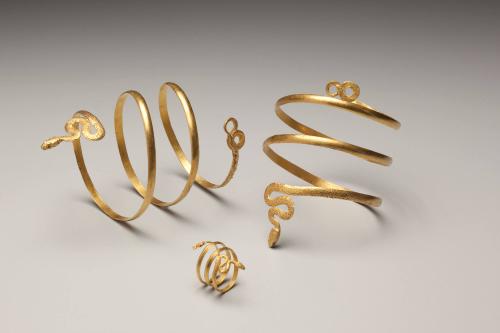

Hair Spiral in the Form of a Snake
Place of OriginLikely Italy, reportedly from Taranto (Apulia)
DateHellenistic Greek, possibly Ptolemaic, about 200-100 BCE
Dimensions1 3/16 × 3/4 × 3/4 in. (3 × 1.9 × 1.9 cm)
MediumGold with enamel (?) inlays
ClassificationJewelry
Credit LinePurchased with funds from the Libbey Endowment, Gift of Edward Drummond Libbey
Object number
1973.32
On View
Toledo Museum of Art (2445 Monroe Street), Gallery, 02, Classic
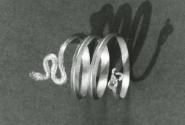
DescriptionA set of gold jewelry comprised of two armbands (1973.30, 1973.31) and one smaller spiral coil (1973.32). The armbands are formed as coiled serpents and are exact mirror images of one another. The heads and foreparts curve in flat S-shapes, while the tails loop back upon themselves in an intricate figure-eight knot. The surface of the heads and tails is treated with a scale pattern created using a U-shaped puncheon, contrasting with the smooth, polished surface of the spiral bodies. The bodies are decorated with incised double chevrons and dotted circles. The eyes of the serpents contain traces of green/turquoise enamel. The smaller coil (1973.32) follows the same general form but features a central raised rib running along the length of the body and a slightly coarser treatment of the tail knot.
Label TextAlexander the Great’s conquest of the ancient world ushered in an age of opulence and wealth evidenced through the surviving jewelry of the period. Jewelry sets such as these two armlets and ring in the form of snakes were popular. The armlets would have been worn on the upper arm and are exact mirror images of each other. The small ring was actually not intended to be worn on the finger as it is larger than the distance between a finger joint and first knuckle. Instead, it is thought to have been used to secure tresses of hair.Published ReferencesLuckner, Kurt T., "Greek gold jewelry," Toledo Museum of Art Museum News, vol. 17, no. 1, 1974, p. 5, 6, repr. fig. 3, p. 6.
Peck, William H., Sandra E. Knudsen and Paula Reich, Egypt in Toledo: The Ancient Egyptian Collection at the Toledo Museum of Art, Toledo, Toledo Museum of Art, 2011, p. 92-93, repr. (col.) p. 92.
Exhibition HistoryChicago, Art Institute, The Search for Alexander, 1981, nos. S-11, 12, 13, repr.New Orleans Museum of Art, The Search for Alexander, supplement, 1982, no. S-3.
St. Petersburg Museum of Fine Arts, Infinite riches; jewelry through the ages, 1989, no. 24, p. 28, repr.
Toledo Museum of Art, The Egypt Experience: Secrets of the Tomb, October 29, 2010-January 8, 2012.
Comparative ReferencesSee also Hoffmann, Herbert and Patricia F. Davidson. Greek Gold, Jewelry from the Age of Alexander, Boston, Museum of Fine Arts, 1966, p. 264, p. 263, fig. 122, p. 277, no. 129, fig. 129.cf. Amandry, Pierre, Collection Helene Stathotos, vol. III, Objets antiques et byzantins, Strasbourg, 1963, pl. XXXIV, no. 161.
cf. Zahn, Robert, Sammlung Baurat Schiller, Berlin, Berlin, Lepke's Kunst-Auctions-Haus, 1929, p. 25, lot 3, taf. 51.
cf. Higgins, R.A., Greek and Roman Jewelry, London, 1961, pl. 53, no. B.
Hellenistic Greek, possibly Ptolemaic, about 200-100 BCE
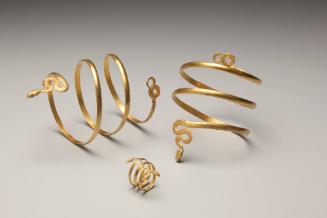
Hellenistic Greek, possibly Ptolemaic, about 200-100 BCE

Chola Dynasty (850-1310), about 950
Chola Dynasty (850-1310), about 950

Perhaps late first or 2nd century

about 490 BCE

about 1785 (Frame about 1820)
about 1785 (Frame about 1820)

12th-11th century BCE
1st century BCE - 1st century CE
750-650 BCE

Membership
Become a TMA member today
Support TMA
Help support the TMA mission