

Hemispherical Bowl from the "Canosa Group"
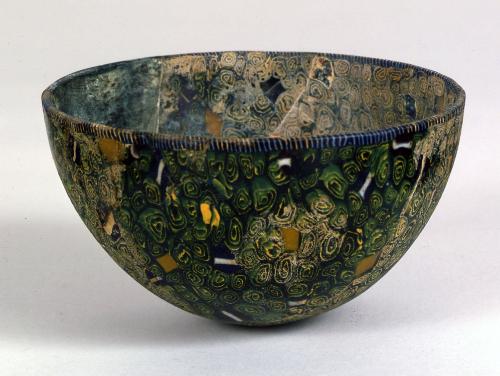

Hemispherical Bowl from the "Canosa Group"
Place of OriginItaly, Apulia, from a tomb group in Canosa
Date2nd century BCE
DimensionsH: 3 in. (7.6 cm); Diam: 5 1/2 in. (13.9 cm)
MediumAssembled from sections and segments of cane and cast; applied rim; rotary-polished on the interior, the top, and the outside of the rim, but possibly not on the rest of the exterior, which has a fire-polished appearance.
ClassificationGlass
Credit LinePurchased with funds from the Libbey Endowment, Gift of Edward Drummond Libbey
Object number
1967.10
Not on View
DescriptionTen joining fragments of hemispherical bowl. Vertical rim with rounded edge; convex curving side; convex bottom. Composite mosaic pattern formed from polygonal sections of a single composite cane in a blue-green ground with an opaque yellow spiral; with a small number of square segments of three additional canes; the first in an opaque yellow ground backed by colorless; the second in a dark blue ground with a central opaque white line; and the third in a purple ground with a central opaque white line. A dark blue network cane wound spirally with an opaque white thread is attached as a rim.
Label TextThis hemispherical millefiori bowl is a notable example of Hellenistic glass production from the early second century B.C. Its name, from the Italian for "a thousand flowers," refers to the intricate, flower-like patterns that cover its surface. A luxury object in antiquity, this glass vessel demonstrates the considerable skill of artisans working in the Eastern Mediterranean or Italy.
This hemispherical mosaic glass bowl is exceptional among surviving examples because it can be associated with a documented archaeological findspot. Although acquired by the Museum through the Sangiorgi Collection, the bowl can be traced, via a surviving photograph formerly owned by the Italian antiquities dealer Barsanti, to a burial at Canosa in southern Italy. That burial reportedly also contained three Ptolemaic faience bowls dated to the third century BCE. A closely comparable Canosan grave yielded a network mosaic bowl together with datable core-formed glass vessels, reinforcing the likelihood that the two burials were roughly contemporary.
Published ReferencesSangiorgi, Giorgio. Collezione di Vetri Antichi dalle Origini al V Secolo D.C. Milan and Rome: Casa Editrice d'Arte Bestetti e Tumminelli, 1914, no. 223, pl. 43.Harden, Donald Benjamin, “The Canosa Group of Hellenistic Glasses in the British Museum,” Journal of Glass Studies, vol. 10, 1968, 31, 37, and 42.
Oliver, Andrew, Jr., “Millefiori Glass in Classical Antiquity,” Journal of Glass Studies, vol. 10, 1968, 59 and 68, no. 8.
Parlasca, Klaus, “Zur Verbreitung ptolemäischer Fayencekeramik ausserhalb Aegyptens,” Jahrbuch des Deutschen Archäologischen Instituts, vol. 91, 1976, 135–150, esp. 147–148, figs. 17–18.
Art in Glass, 1969, p. 20, ill.
Gunther, Charles F., "How Glass is Made," Toledo Museum of Art Museum News, 1972, no. 1, p. 16, ill.
Grose, David F., "Ancient Glass," Toledo Museum of Art Museum News, 20, 1978, no. 3, p. 73, fig. 7.
Grose, David F., "The Origins and Early History of Glass," in The History of Glass, eds. Dan Klein and Ward Lloyd, London, 1984a, p. 22, ill.
Grose, David F., Early Ancient Glass: Core-Formed, Rod-Formed, and Cast Vessels and Objects from the Late Bronze Age to the Early Roman Empire, 1600 B.C. to A.D. 50, New York, Hudson Hills Press in association with the Toledo Museum of Art, 1989, Cat. No. 184, p. 198, Repr. (col.) p. 178.
Second to mid-1st century BCE
2nd to mid-1st century BCE

1st century BCE
probably 2nd century BCE

Late 1st century BCE to early 1st century CE
Late 1st century BCE to early 1st century CE
Late 1st century BCE to early 1st century CE
Late 1st century BCE to early 1st century CE

Late 1st century BCE to early 1st century CE
Late 1st century BCE to early 1st century CE
Late 1st century BCE to early 1st century CE
Late 1st century BCE to early 1st century CE

Membership
Become a TMA member today
Support TMA
Help support the TMA mission