

Roman Hand Mirror with Modern Resin Assembly
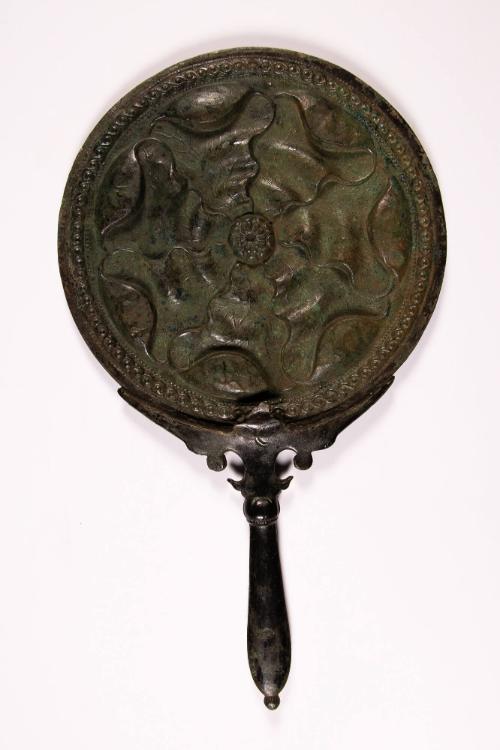


Roman Hand Mirror with Modern Resin Assembly
Place of OriginRoman Empire
Date1st century BCE-1st century CE (or modern)
DimensionsH: 12 15/16 in. (32.9 cm); Diam (disk): 7 9/16 in. (19.2 cm); H (handle to edge of disk): 5 3/8 in. (13.7 cm); W (handle bracket): 5 3/8 in. (13.7 cm)
MediumComposite: Ancient bronze handle and silver disk joined with modern resin; silver inlays.
ClassificationMetalwork
Credit LinePurchased with funds from the Florence Scott Libbey Bequest in Memory of Her father, Maurice A. Scott, and Gift of Florence Scott Libbey, by exchange
Object number
1995.6
Not on View
DescriptionA handheld mirror composed of a circular reflecting disk and a cast baluster-shaped handle. The reflecting surface is a convex sheet of polished silver. The reverse of the disk features a large, high-relief repoussé lotus blossom with detailed veining, surrounded by a guilloche border and beading. The bronze handle is decorated with floral, scroll, and tongue patterns. At the junction with the disk, the handle flares into two crane heads with long bills extending along the disk's rim . Technical analysis indicates the handle, disk, and decorative backplate are held together entirely by modern resin, with no metal-to-metal contact .
Label TextAt first glance, this mirror appears to be a luxurious Roman accessory from the 1st century A.D., decorated with "Egyptianizing" motifs like lotus flowers and cranes that were popular after Rome annexed Egypt. However, scientific analysis tells a more complex story. Museum conservators discovered that the bronze handle and silver disk are held together entirely by modern glue, not ancient craftsmanship. This suggests the object is likely a "composite"—a modern assembly of different ancient fragments put together to look like a complete, pristine object.
150-100 BCE
Probably first half of 1st century
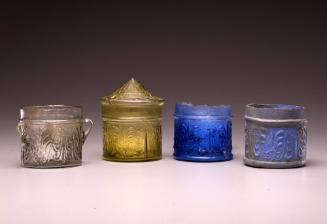
Second half of the 1st century CE
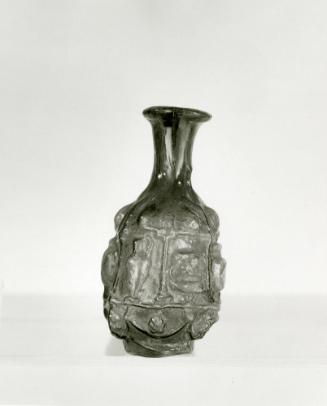
Probably first half of 1st century
3rd through 2nd century BCE
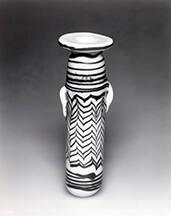

100 BCE to 150 CE
2nd through mid-1st century BCE
2nd through mid-1st century BCE
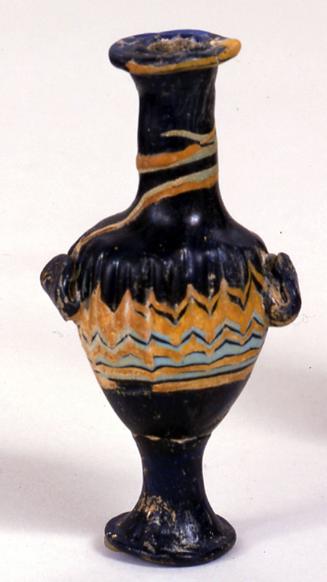
3rd century BCE

Late 6th through 5th century BCE

Membership
Become a TMA member today
Support TMA
Help support the TMA mission