

Set of 12 Silver Cocleria (Snail Spoons)
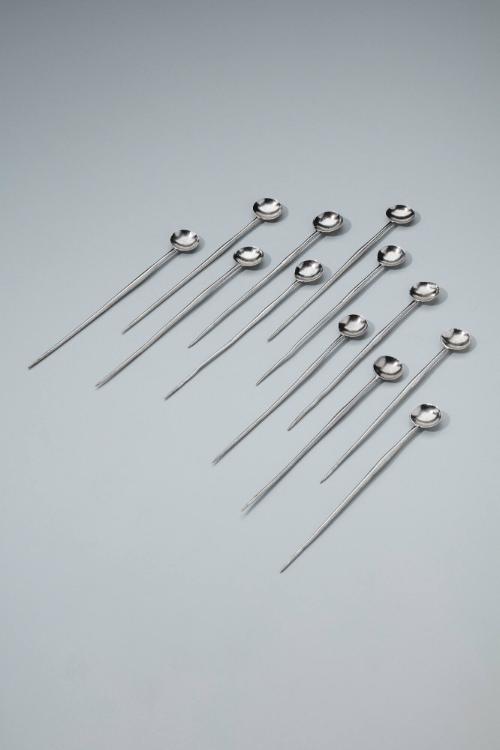

Set of 12 Silver Cocleria (Snail Spoons)
Place of OriginProbably Turkey (reported by dealer)
Date150-100 BCE
DimensionsL: 4 1/8 in. (10.5 cm) to 4 1/4 in. (10.8 cm); Diam (bowls): 1/2 in. (1.3 cm) to 9/16 in. (1.4 cm); Weights: 3.5 to 4.4 grams
MediumSilver
ClassificationMetalwork
Credit LinePurchased with funds from the Libbey Endowment, Gift of Edward Drummond Libbey
Object number
1984.68A-L
On View
Toledo Museum of Art (2445 Monroe Street), Gallery, 02, Classic
DescriptionA matching set of twelve silver spoons with slender handles and small, elliptical bowls, identified as cocleria.
Label TextThe ancient Greeks and Romans used this type of small, slender-handled spoon, called a cochlear, for eating snails, shellfish, and eggs. These are the smallest and earliest snail spoons known in Greek or Roman silver tableware. Less luxurious examples of the same shape have been found in bone. However, ancient Greeks and Romans typically used minimal tableware, instead eating with their fingers.Published ReferencesOliver, Andrew Jr., "New Hellenistic Silver: Mirror, Emblem Dish and Spoons," Jahrbuch der Berliner Museen, vol. 19, 1977, pp. 13-22.
"Important Egyptian, Classical, and Near Eastern Antiquities, Sotheby Catalogue, June 10 and 11, 1983," New York, 1983, lot 110.
Exhibition HistoryThe Toledo Museum of Art; Kansas City, Atkins Museum of Fine Art; Fort Worth, The Kimbell Art Museum, Silver for the Gods: 800 Years of Greek and Roman Silver, 1977-1978, no. 54, p. 91.
about 550-400 BCE
2nd-5th century CE
150-100 BCE


1815
4th-5th century CE

18th Dynasty (1550-1292 BCE), about 1350–1300 BCE
Related Object/Related Object

Membership
Become a TMA member today
Support TMA
Help support the TMA mission