

Cameo Glass Plaque Fragment with Draped Leg and Sandaled Foot
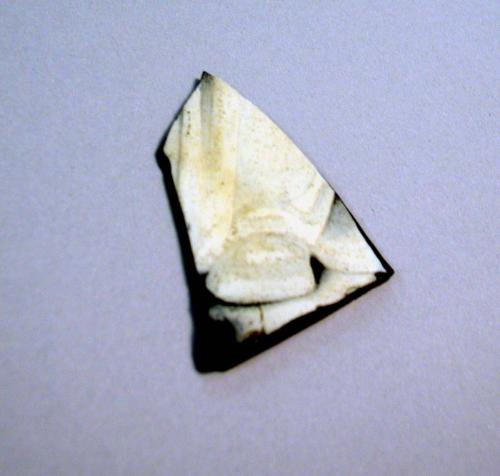

Cameo Glass Plaque Fragment with Draped Leg and Sandaled Foot
Place of OriginItaly, likely Rome or Bay of Naples
Dateabout 15 BCE - 25 CE (Roman, Augustan)
Dimensions1.8 x 2.44 in.
MediumFoot and drapery in opaque white on a translucent cobalt blue ground.
ClassificationGlass
Credit LineGift of Edward Drummond Libbey
Object number
1923.1530
Not on View
DescriptionThis flat fragment of a cameo glass plaque is composed of opaque white glass over a translucent cobalt blue ground. It preserves a draped left leg and a sandaled foot in frontal view, leaning to the right and resting on a ground or rock. The figure is rendered using the cameo technique.
Label TextAcquired by Edward Drummond Libbey in 1919 from the family of Thomas Hulse Curtis. The Curtis collection was largely acquired in the 1890s from Charles Caryl Coleman, an American artist who resided first in Rome and later on the island of Capri. This collection history strongly suggests a findspot in or around Rome or the Bay of Naples.Early first to 4th century CE
about 15 BCE - 25 CE (Roman, Augustan)

1st century BCE - 3rd century CE

1st century BCE - 3rd century CE

1st century CE
1st century BCE - 3rd century CE

about 15 BCE - 25 CE (Roman, Augustan)
Early Imperial Period

1st-2nd century CE

probably 1st-2nd Century

Possibly early Imperial Period

Membership
Become a TMA member today
Support TMA
Help support the TMA mission