

Gold-Band Alabastron (Unguent Bottle)
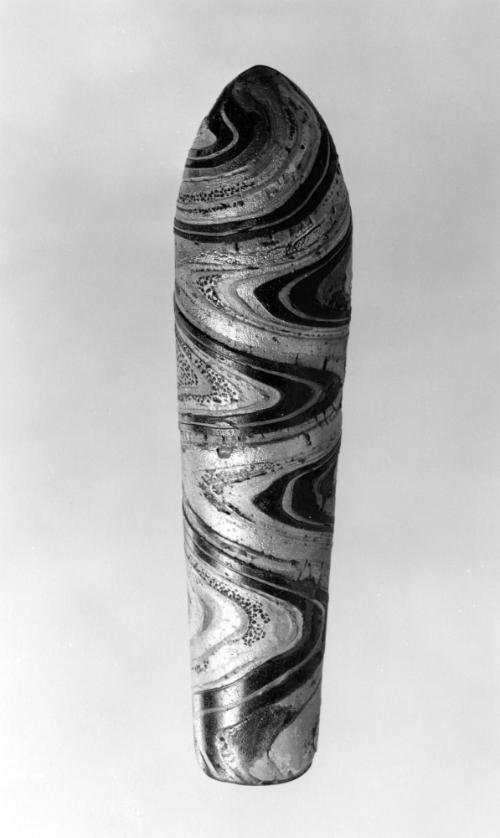

Gold-Band Alabastron (Unguent Bottle)
Place of OriginEastern Mediterranean or Italy
Date1st century BCE
DimensionsH: 3 5/8 in. (9.2 cm.); Diam: 9/16 in. (1.4 cm)
MediumGold-band alabastron; assembled from lengths of cane and cast, probably around a rod; rotary-polished on the exterior.
ClassificationGlass
Credit LinePurchased with funds from the Libbey Endowment, Gift of Edward Drummond Libbey
Object number
1951.406
Not on View
DescriptionA tall, slender vessel with a flat-edged upright rim and straight sides that taper upward from a convex, pointed bottom. The body features a multicolored, wavy "gold-band" mosaic pattern created from four distinct vertical glass canes. The repeating cane sequence consists of: opaque medium blue; dark blue with a central opaque white line and streaks; golden-yellow; and colorless glass encasing shattered gold leaf. The exterior surface is rotary-polished, while the interior shows patches of weathering.
Label TextThis luxurious vessel, known as an alabastron, was designed to hold scented oils or precious perfumes. It is a prime example of "gold-band" glass, a highly technical luxury ware produced during the early Roman Empire. The vessel was not blown, but rather cast from separate lengths of glass canes—including strips of colorless glass encasing real gold leaf—which were fused together and then rotary-polished to create a smooth, seamless surface. The shimmering gold and wavy mosaic pattern were intended to imitate semi-precious stones, making the container as valuable as the unguents it held.Published ReferencesRiefstahl, Rudolf M., "Ancient and Near Eastern Glass," TMA Museum News 4, no. 2, 1961, p. 34, ill.
Grose, David F., "Innovation and change in ancient technologies: The anomalous case of the Roman glass industry," in High-technology ceramics, Westerville, OH, 1986, p. 73, fig. 12, p. 75.
Grose, David F., Early Ancient Glass: Core-Formed, Rod-Formed, and Cast Vessels and Objects from the Late Bronze Age to the Early Roman Empire, 1600 B.C. to A.D. 50, Hudson Hills Press in Association with the Toledo Museum of Art, New York, 1989, cat. no. 225, p. 208, drawing, p. 412.
Early to mid-1st century CE
Early to mid-1st century CE
2nd to mid-1st century BCE
Late 1st century BCE to early 1st century CE
Second to mid-1st century BCE
Late 1st century BCE to early 1st century CE
Late 1st century BCE to early 1st century CE
Late 1st century BCE to early 1st century CE
Late 1st century BCE to early 1st century CE
Late 1st century BCE to early 1st century CE
Late 1st century BCE to early 1st century CE

Membership
Become a TMA member today
Support TMA
Help support the TMA mission