

Cylindrical Box with Three Handles (Pyxis)
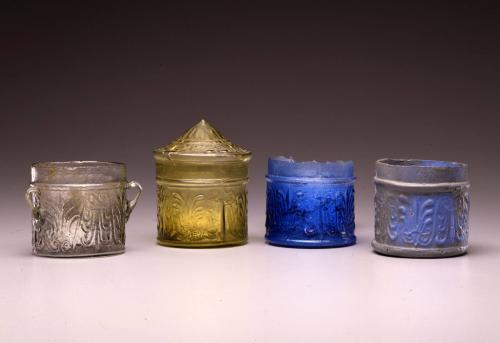

Cylindrical Box with Three Handles (Pyxis)
Place of OriginLikely produced in Sidon, Lebanon; reportedly from Hebron, West Bank
DateProbably second half of the 1st century CE
DimensionsH: 2 1/8 in. (7.4 cm);
Rim Diam: 2 1/4 in. (5.71 cm);
Max Diam: 2 3/8 in. (6.0 cm);
Thickness of Rim: 1/16 in. (0.16 cm);
Base Diam: 2 1/4 in. (5.7 cm)
Rim Diam: 2 1/4 in. (5.71 cm);
Max Diam: 2 3/8 in. (6.0 cm);
Thickness of Rim: 1/16 in. (0.16 cm);
Base Diam: 2 1/4 in. (5.7 cm)
MediumMedium thick glass. Mold blown.
ClassificationGlass
Credit LinePurchased with funds from the Libbey Endowment, Gift of Edward Drummond Libbey
Object number
1956.3
Not on View
DescriptionThis cylindrical vessel is blown into a three-part mold consisting of two vertical sections joined to a disk-shaped base. The transparent, decolorized glass features pale green areas and manganese-colored purple streaks. The body displays a continuous relief frieze of eight stiff, seven-leaf palmettes that alternate between upright and inverted orientations. The rim is unworked and inset with a mold-blown ridge intended to support a lid, which is now missing. Three applied coil handles connect the middle of the body to the lower edge of the rim ridge. The flat underside of the base features four raised concentric circles surrounding a small central depression
Label TextThis small, cylindrical container was likely used to hold cosmetics, powders, or jewelry. It was formed by blowing a bubble of hot glass into a three-part mold carved with a frieze of palm leaves (palmettes). While the Toledo Museum of Art owns three other boxes made from this exact same mold, this example is unique because of its handles. When it was discovered near Hebron in the 1950s, the dealer believed the tiny handles meant it was a hanging lamp. However, the shape of the rim—designed to hold a lid—identifies it as a pyxis, a popular shape for personal toiletry items in the Roman East.Published ReferencesRiefstahl, Rudolf M., "The Tradition of Glass: Ancient and Near Eastern Glass," The Toledo Museum of Art Museum News 4 (1961), p. 37, ill.
Labino, Dominick, Visual Art in Glass, Dubuque, IA, 1968, p. 21, fig. 8.
Stern, E. Marianne, Roman Mold-blown Glass: the First through Sixth Centuries, "L'Erma" di Bretschneider in Association with the Toledo Museum of Art, Rome, Italy, 1995, cat. no. 82, p. 171-172, pl. 82, p. 55, colorpl. 15.
Second half of the 1st century CE
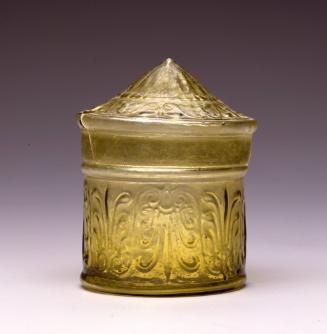
Second half of the 1st century CE
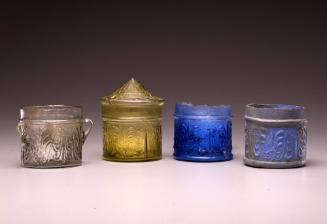
Second half of the 1st century CE

First half of the 1st century
4th century CE

Probably 3rd century

Second to third quarter of 1st century CE
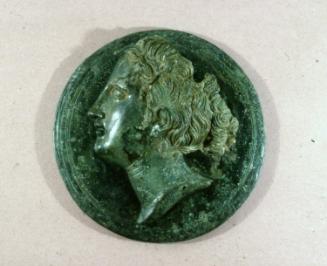
about 320 BCE
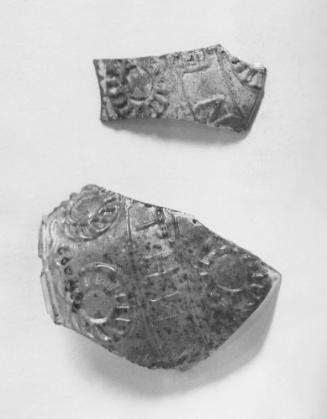
First half of 1st century

First half of 1st century

1st-2nd century CE

Probably 3rd century

Membership
Become a TMA member today
Support TMA
Help support the TMA mission