

Snake-Thread Sprinkler Flask
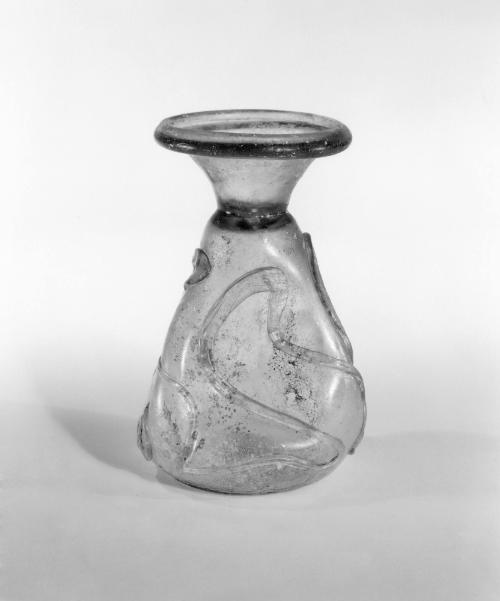

Snake-Thread Sprinkler Flask
Place of OriginSyria, reportedly from Homs (ancient Emesa)
Date2nd-3rd century CE
DimensionsH: 3 7/8 in. (9.9 cm); Rim Diam: 2 1/16 in. (5.3 cm); Body Diam: 2 3/4 in. (7 cm)
MediumFree-blown glass with applied tooled trails
ClassificationGlass
Credit LinePurchased with funds from the Libbey Endowment, Gift of Edward Drummond Libbey
Object number
1951.374
Not on View
DescriptionA free-blown glass sprinkler flask of transparent grayish-green glass. The vessel features a short, cylindrical neck that flares into a wide, funnel-shaped rim folded outward, upward, and inward. At the base of the neck, the glass is constricted internally to form a horizontal diaphragm with a tiny central aperture (approx. 0.3 mm), restricting liquid flow. The body is piriform (pear-shaped) with four deep, oval indentations (pinched sides) that give it a pyramidal volume. The exterior is decorated with applied trails of glass in the same color as the body; these trails are tooled with transverse notches (hatching) and wound in irregular, snake-like S-curves across the indented surfaces. The base is concave with a circular pontil mark.
Label TextThis indented flask is a prime example of the "Eastern Snake-Thread" style, a decorative technique that flourished in the Levant before spreading to Western Roman workshops in Cologne. The vessel is free-blown from monochrome grayish-green glass. Its functional typology is that of a sprinkler or dropper flask: the base of the neck contains a folded internal diaphragm with a minute aperture, engineered to dispense expensive oils or perfumes drop-by-drop.
The decoration consists of applied trails of the same glass batch, flattened and cross-hatched (notched) to create a ribbed, ribbon-like texture, then wound in abstract, sinuous curves over the four indented sides of the body. The provenance of Homs (ancient Emesa) is historically resonant; Emesa was a hub of the Severan dynasty, and archaeological evidence connects Emesan auxiliary troops (cohors I milliaria Hemesenorum) to the transmission of snake-thread glass technology to provinces such as Pannonia.
Published ReferencesToledo Museum of Art, Art in Glass: A Guide to the Glass Collections, Toledo, 1969, p. 26. Grose, David F., "Ancient Glass," Toledo Museum of Art Museum News, vol. 20, no. 3, 1978, p. 82, repr. fig 21Comparative ReferencesCf. Stern, E. Marianne, Roman, Byzantine, and Early Medieval Glass: Ernesto Wolf Collection, Ostfildern-Ruit, Hatje Cantz, 2001, pp. 152–153 (for discussion of type).
Late 4th-5th century CE

3rd-4th century CE
First half of 3rd century

7th-8th century
8th-9th century
13th century

3rd-4th century CE
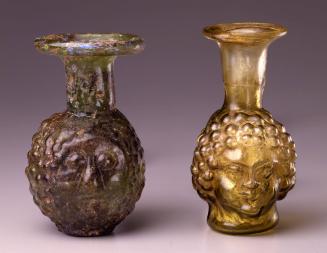
Probably early 3rd century
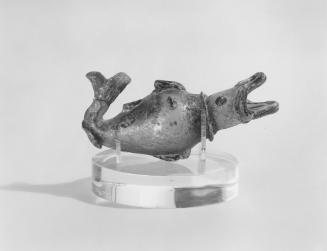
3rd-4th century CE

5th-6th century CE

Membership
Become a TMA member today
Support TMA
Help support the TMA mission