

Gold-Glass Medallion with Charioteer Vincentius and Horse Invictus


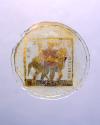


Gold-Glass Medallion with Charioteer Vincentius and Horse Invictus
Place of OriginItaly, Rome
Date350-400 CE (or modern)
DimensionsH: 1 9/16 in. (4 cm); W: 1 3/4 in. (4.4 cm); Diam: 2 1/2 in. (6.4 cm)
MediumColorless glass; blown, gold leaf, enameling
ClassificationGlass
Credit LinePurchased with funds from the Libbey Endowment, Gift of Edward Drummond Libbey
Object number
1967.11
Not on View
DescriptionCircular, slightly concave medallion composed of two layers of transparent, slightly greenish glass fused together. The design consists of a layer of gold leaf sandwiched between the glass layers, depicting a standing male figure and a horse. The figure stands frontally, holding a palm branch in his left hand and the horse's bridle in his right. He wears a long-sleeved tunic, a protective chest harness, belt, and leg wrappings. The horse stands in profile to the left. Details of the figure's tunic and the horse's tack are highlighted with red enamel. A Latin inscription (VINCENTI NIKA) frames the scene in the gold leaf, and a second inscription (IMBICTUS) is scratched into the gold band at the bottom. The edges of the medallion are chipped where the base was snapped from the original vessel.
Label TextThis medallion, a fondo d'oro (gold-glass), depicts a victorious charioteer of the Red Faction. The figure stands frontally, grasping a palm branch of victory and the bridle of his horse. He is dressed in the full technical apparatus of the late Roman auriga: a long-sleeved tunic (tunica manicata), a protective leather corset of thongs (fasciae pectoralis), and heavy leg wrappings (fasciae crurales) with knee-guards. The surviving red enamel pigment on his tunic and the horse's trappings identifies his team allegiance.
Two inscriptions identify the subjects. The border text, VINCENTI NIKA, is a bilingual acclamation: "Vincentius, Win!" (using the Greek verb nika). The inscription scratched into the exergue, IMBICTUS, identifies the horse as "Invictus" (Unconquered), utilizing a betacism (B for V) characteristic of Late Latin pronunciation. This piece has a near-identical counterpart in the Kunsthistorisches Museum, Vienna (XI 1734), which depicts a charioteer of the Blue Faction, suggesting they were produced by the same workshop, possibly as part of a set representing the four circus factions.
The authenticity of the TMA medallion has recently been questioned, but the issue remains unresolved.
Published References"Recent Important Acquisitions," Journal of Glass Studies, vol. XI, 1969, p. 111, repr. no. 13.Toledo Museum of Art, Art in Glass, A Guide to the Glass Collections, Toledo, 1969, repr. p. 27.
Noll, Rudolf, "An Instance of Motif Identity in Two Gold Glasses," Journal of Glass Studies, vol. XV, 1973, p. 31-34, repr. fig. 1.
"Imperial Realm," Metropolitan Museum of Art Bulletin, vol. 35, no. 2, Autumn 1977, p. 19, repr.
Grose, David, "Ancient Glass," Toledo Museum of Art Museum News, vol. 20, no. 3, 1978, p. 86, repr. fig. 27.
Weitzmann, Kurt, ed., Age of Spirituality : Late Anitque and Early Christian Art, 3rd-7th Century, New York, Metropolitan Museum of Art, 1979, repr. p. 104, no. 95 (cat. entry by Stephen R. Zwirn).
Goldman, Bernard M., "The Later Pre-Islamic Riding Costume," Iranica Antiqua, vol. 28, 1993, p. 215, n. 50, pl. II-1, p. 241.
Page, Jutta-Annette, The Art of Glass: Toledo Museum of Art, Toledo, OH, Toledo Museum of Art, 2006, repr. (col.) fig. 14.1, p. 42.
Dunbabin, Katherine M.D., Theater and Spectacle in the Art of the Roman Empire, Ithaca, Cornell University Press, 2016, p. 239, repr. (col.) fig. 8.2.
Bell, Sinclair W., “The Costume of the Roman Charioteer: New Insights from a Statue Fragment in Hadrumentum (Sousse) and Related Sources,” Boreas. Münstersche Beiträge zur Archäologie, vol. 41/42, 2018/2019, p. 77, pl. 33,3.
Exhibition HistoryNew York, Metropolitan Museum of Art, Age of Spirituality, 1977-78, no. 95.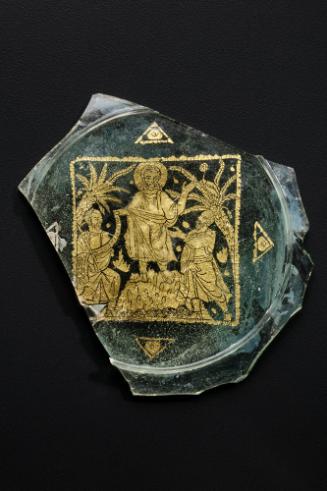
about 370-400 CE
about 1500

about 9th-12th century
about 9th-12th century


about 1740

1780-1820

1780-1820

1780-1820

Membership
Become a TMA member today
Support TMA
Help support the TMA mission