

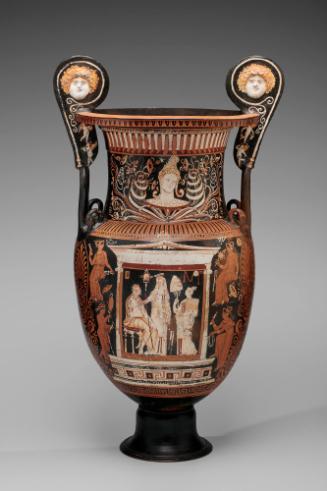
Volute Krater with Dionysus and Ariadne


Volute Krater with Dionysus and Ariadne
Artist
Creusa Painter
(Greek, active about 410-370 BCE)
Place of OriginItaly, Lucania
Dateabout 400-380 BCE
DimensionsOverall (with handles): 23 3/8 × 18 × 14 1/4 in. (59.4 × 45.7 × 36.2 cm)
H (to rim): 20 3/16 in. (51.3 cm)
Body Diam: 14 9/16 in. (37 cm)
Base Diam: 6 7/8 in. (17.5 cm)
Rim Diam: 13 1/4 in. (33.7 cm)
H (to rim): 20 3/16 in. (51.3 cm)
Body Diam: 14 9/16 in. (37 cm)
Base Diam: 6 7/8 in. (17.5 cm)
Rim Diam: 13 1/4 in. (33.7 cm)
MediumWheel-thrown, slip-decorated, red-figure earthenware.
ClassificationCeramics
Credit LinePurchased with funds from the Libbey Endowment, Gift of Edward Drummond Libbey
Object number
1981.110
On View
Toledo Museum of Art (2445 Monroe Street), Gallery, 02, Classic
DescriptionA large volute krater with a flaring rim and elaborate coiled handles decorated with ivy bands and reddened negative space. The obverse (Side A) features a multi-level composition centered on Dionysos and Ariadne seated in a cave, framed by an undulating reserved band, incised grass, and grapevines. Above them, Pan and a satyr harvest grapes. To the left, a satyr carries a maenad playing the aulos; to the right, satyrs and maenads engage in revelry. The reverse (Side B) depicts two registers: a woman pouring a libation for a departing warrior (left) and a woman crowning a victorious youth with a wreath (right).
Label TextThis monumental vessel was created to hold wine mixed with water, but its size and elaborate decoration suggest it was made exclusively for a tomb. The central scene depicts the "Sacred Marriage" of the wine god Dionysos and his mortal wife, Ariadne. Seated tenderly in a cave filled with vines, Ariadne crowns Dionysos with a laurel wreath, symbolizing triumph over death and the promise of a blessed afterlife. Around them, a lively retinue of satyrs, maenads, and the forest god Pan prepares for an eternal celebration. Produced by the Creusa Painter in southern Italy, this work is a masterpiece of Lucanian art, celebrated for its ambitious multi-level landscape and emotional depth, offering comfort and status to the deceased's family.Published ReferencesLuckner, Kurt T., in The Art of South Italy: Vases from Magna Graecia, Richmond, 1982, no. 6, pp. 63-66.
Boulter, Cedric G., and Kurt T. Luckner, Corpus Vasorum Antiquorum, Toledo Museum of Art, fasc. 2, U.S.A., fasc. 20, Mainz, 1984, pl. 91, 92, 93, pp. 16-18.
Toledo Museum of Art, Toledo Treasures, Toledo, 1995, p. 41, repr. (col.).
Sparkes, Brian A., The red and the black: studies in Greek pottery, London, 1996, p. 21, fig. I:16, p. 24.
Camitoglou, Alexander, "Lucani, vasi," in Enciclopedia dell'arte antica, classica e orientale, secondo supplemento, 3 (H-Neo), Rome, 1995, p. 429, fig. 520.
Lexicon iconographicum mythologiae classicae (LIMC), Zurich, 1981-1999, vol. III, pt. 1, p. 485, no. 741, repr. vol. III, pt. 2, p. 385.
Dorr, Erin, "Fragments of a lost culture," Perspectives [Ohio University], vol. 10, no. 1, Spring-Summer 2006, side A, repr. p. 1 (det., col.) and p. 21 (det., col.).
Söldner, Magdalene, Bios Eudaimon: zur Ikonographie des Menschen in der rotfiguren Vasenmalerei Unteritaliens: die Bilder aus Lukanien, [Möhnesee] Bibliopolia, 2007, p. 92 no.694, 94 nos. 709 and 717, Abb. 130.
Buxton, Richard, Den grekiska mytologins värld, Stockholm, Prisma, 2007, repr. (Side A), p. 4, and (det.) on front cover (col.).
Indianapolis Opera, Indianapolis Opera 2009-2010 Season Program, 2009, repr. (col.det.), front and back cover.
Thorn, Jed, "New Evidence for Apulian Red-Figure Production Centers," Archaeometry, vol. 52, no. 5, Oct. 2010, repr. (col.) p. 783.
Exhibition History"The Art of South Italy: Vases from Magna Graecia," Virginia Museum of Fine Arts, Richmond (May 12 - Aug. 8, 1982); Philbrook Art Center (Nov. 20, 1982 - Jan. 9, 1983); The Detroit Institute of Arts, Detroit (Feb. 7 - Apr. 10, 1983) no. 6.Ann Arbor, Kelsey Museum of Archaeology and The University of Michigan Museum of Art, The Villa of the Mysteries in Pompeii: ancient ritual, modern muse, 2000, no. 72, pp. 207-208, repr.





Membership
Become a TMA member today
Support TMA
Help support the TMA mission