

Gold Glass Medallion with Christ Giving the Law (Traditio Legis)


Gold Glass Medallion with Christ Giving the Law (Traditio Legis)
Place of OriginItaly, Rome
Dateabout 370-400 CE
DimensionsH: 2 5/16 in. (5.9 cm); Max Diam: 4 7/8 in. (12.4 cm)
MediumColorless glass, blown; gold leaf.
ClassificationGlass
Credit LinePurchased with funds from the Libbey Endowment, Gift of Edward Drummond Libbey
Object number
1967.12
Not on View
DescriptionAn irregular, roughly hexagonal fragment from the base of a shallow glass bowl or cup. The object consists of two layers of colorless glass fused together, sandwiching a layer of gold leaf. The glass has a natural grayish-green tint (approx. 10 GY 5/2). The central decoration is a square panel containing three standing male figures executed in gold leaf with incised internal details. The central figure stands frontally on a rock-like mound from which four streams issue; he is bearded, has a nimbus, and wears a tunic and pallium. To his left (viewer's right), a figure approaches with covered hands to receive an unfurled scroll held by the central figure. To his right (viewer's left), a third figure stands with one arm raised in a gesture of acclamation. Palm trees frame the scene on both sides. The scene is bordered by a square frame, surrounded by four triangular motifs containing circular elements. The inscription on the scroll reads: DOMINVS LEGE DAT.
Label TextThis gold glass fragment, preserved from the base of a vessel, depicts the Traditio Legis (Giving of the Law), a theme popularized in Roman Christian art during the fourth century CE. The scene features Christ standing centrally on a mound representing Paradise, from which the four rivers of Eden flow. Unlike earlier representations of a youthful Christ, here he is depicted as a mature, bearded figure with a nimbus, a physiognomy that became standard in the late fourth century. Christ holds an unfurled volumen (scroll) in his left hand, extending it toward St. Peter, who approaches from the viewer's right with hands covered by his garment (a sign of reverence for a sacred object). St. Paul stands on the viewer's left, gesturing in acclamation. The scene is framed by two date palms; a birdp (possibly a phoenix symbolizing the Resurrection), perches in the tree on the left. The scroll bears the inscription DOMINVS LEGE[M] DAT. The grammatical accusative ending 'M' is missing from LEGEM. The object belongs to a class of luxury glass vessels often found pressed into the mortar of loculi in Roman catacombs, serving as grave markers or commemorative objects.Published ReferencesRiefstahl, Rudolf M., "The Complexities of Ancient Glass," Apollo, vol. 86, no. 70, Dec. 1967, p. 432, repr. (b&w), fig. 13, p. 433.
"Recent Important Acquisitions," Journal of Glass Studies, vol. XI, 1969, p. 111, repr. no. 14.
Toledo Museum of Art, "Treasures for Toledo," Museum News, New Series, vol. 12, no. 4, Winter 1969, repr.
Toledo Museum of Art, Art in Glass, A Guide to the Glass Collections, Toledo, 1969, repr. p. 29.
Grose, David, "Ancient Glass," Toledo Museum of Art Museum News, vol. 20, no. 3, 1978, p. 86, repr. o. 26.
Grose, David, "The Origins and Early History of Glass," in The History of Glass, London, 1984, repr. (col.) p. 35.
Tsuchiya, Yoshio, Fantasy in Glass, Kyoto, Tankosha, 1997, p. 28, repr. [text in Japanese].
Bøgh Rasmussen, Mikael, "Traditio legis?", Cahiers archéologiques. Fin de l'antiquité et Moyen Âge, vol. 47, 1999, 5-37, esp. p. 9.
Page, Jutta-Annette, The Art of Glass: Toledo Museum of Art, Toledo, Ohio, Toledo Museum of Art, 2006, repr. (col.) p. 42.
Spier, Jeffrey, Picturing the Bible: The Earliest Christian Art, Fort Worth, Kimbell Art Museum, 2007, no. 65, pp. 114, 243.
Couzin, Robert, The Traditio Legis: Anatomy of an Image, Oxford, Archaeopress, 2015, p. 8, fig. 49.
Bergmeier, Armin F., "The Traditio Legis in Late Antiquity and Its Afterlives in the Middle Ages," Gesta, vol. 56, no. 1, Spring 2017, p. 30.
Noga-Banai, Galit, Sacred Stimulus: Jerusalem in the Visual Christianization of Rome, New York, Oxford University Press, 2018, p. xiii, 46, 52-53, pl. 2 (col.) p. 203.
Exhibition HistoryNew York, The Metropolitan Museum of Art, Age of Spirituality, 1977-8, no. 503, repr. p. 560 (cat. entr. by Margaret E. Frazier).Fort Worth, Kimbell Art Museum, Picturing the Bible: The Earliest Christian Art, 2007-08, no. 65, pp. 114, 243, repr. (col.) p. 243.
Comparative ReferencesMorey, C.R., The Gold-Glass Collection of the Vatican Library, 1959, no. 78 for a fragmentary parallel.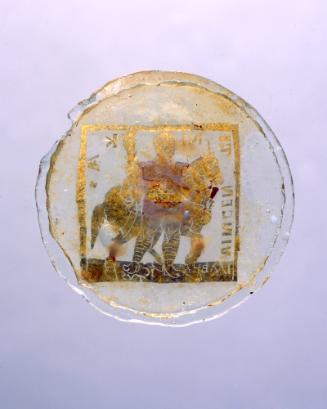
19th or 20th century

![[Netherworld Well Peep Show]](/internal/media/dispatcher/80209/thumbnail)


1st-2nd century CE



280-290 CE (with 15th century recarving)

Ptolemaic Period (332–30 BCE), about 246–222 BCE


Membership
Become a TMA member today
Support TMA
Help support the TMA mission